How to Get Your Business Cited by ChatGPT and Copilot
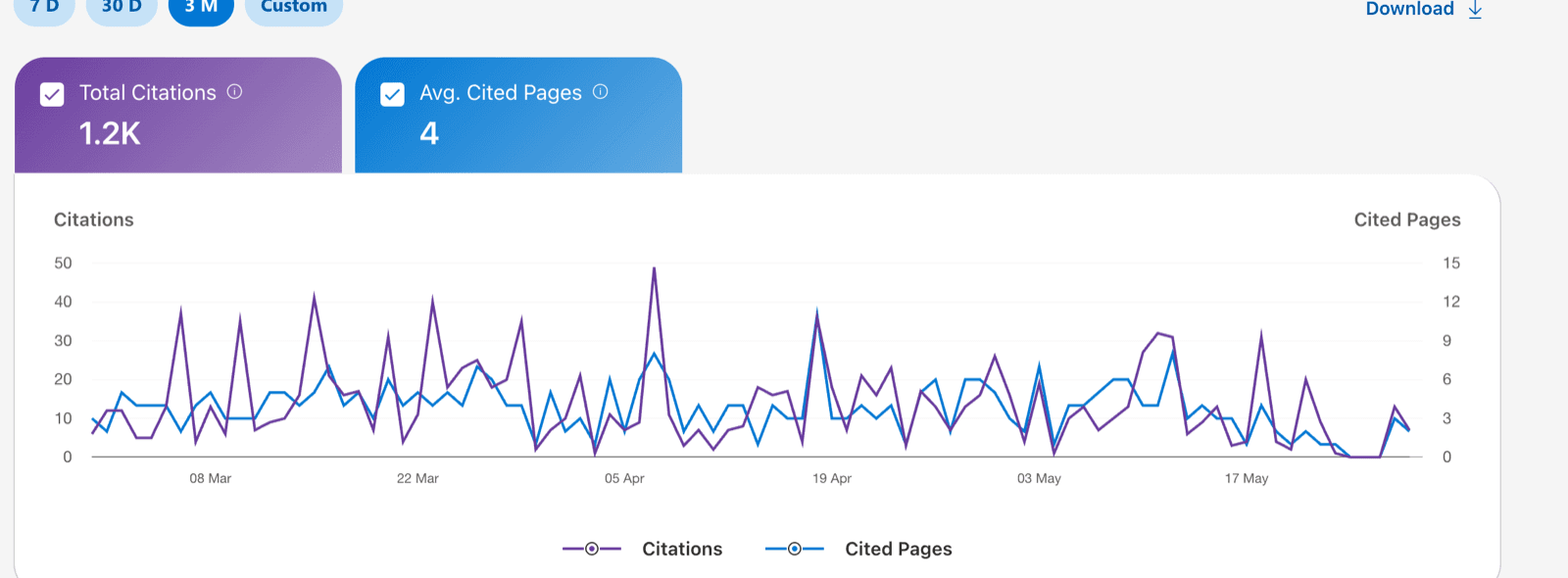
Most AI search advice is theory. Here is how to get cited by ChatGPT and Copilot, with real data: 1,200+ Copilot citations for one Glide client.
Key Takeaways
- People now ask ChatGPT, Copilot and Perplexity for recommendations. The answer cites a handful of sources, and being one of them is the new page one.
- This is measurable today, not theory. One Glide client has earned over 1,200 Microsoft Copilot citations, tracked in Bing Webmaster Tools.
- AI engines reward the boring fundamentals: clean semantic structure, schema markup, specific content with real numbers, consistent business details, and not blocking AI crawlers.
- You can check your own AI visibility for free in Bing Webmaster Tools, and by asking the assistants your own buying questions.
- Honest version: nobody can guarantee citations, volumes are still smaller than Google, and anyone selling "AI search magic" is selling hype. The work is practical and most of it is technical SEO done properly.
Before writing this, I read the guides currently ranking for "ai search optimisation". They are full of frameworks, acronyms and percentages quoted from third-party studies. What almost none of them show is their own data: a real business, a real chart, real citations they can point at.
So this post does the opposite. I will show you the actual Copilot citation data for one of our clients, explain what we did to earn it, and tell you straight what this work can and cannot do.
What is changing in search
For twenty years, finding a local business meant typing into Google and scanning ten blue links. That habit is breaking. People now ask ChatGPT to recommend an accountant. They ask Copilot, which sits inside Windows and Microsoft Edge by default, whether a company is any good. They ask Perplexity to compare three suppliers.
The big shift is in how the answer comes back. There is no page of links to scroll. The assistant writes a paragraph and cites a small number of sources it trusted to build that answer. If your business is one of those sources, you are in the conversation. If not, you are invisible, even if you rank well in Google.
Being cited is the new page one. And right now, very few UK businesses are even trying to earn it, which is exactly why it is worth your attention.
The real data: 1,200+ Copilot citations for one client
Here is the part most articles on this topic cannot show you. One of our SEO clients has earned over 1,200 Microsoft Copilot citations. That means more than 1,200 times, Copilot has used their website as a source when answering someone's question.

This is not a screenshot from a vendor's sales deck and it is not an estimate from a third-party tool. It comes straight from Bing Webmaster Tools, which now reports how often Copilot cites your pages. Anyone can open the same report for their own site, today, for free.
I want to be clear about what this is and is not. It is proof that the work is measurable and that a normal UK business, not a tech giant, can earn a meaningful AI presence. It is not a guarantee that your business will get the same numbers. Nobody can promise that, and you should walk away from anyone who does.
What AI engines reward
There is no secret trick here. When we dug into why this client earns citations, every reason traced back to fundamentals we had already built for ordinary SEO. Here is the list, in plain English.
1. Clean semantic structure
AI systems read your page the way a crawler does: as code. If your page is a soup of anonymous divs with headings chosen for font size, the machine has to guess what anything means. If it has one clear h1, sections with sensible h2s, and tags that describe what content is, the machine can pull out the exact answer it needs. I wrote a full guide on this, using our own homepage as the example: semantic HTML for SEO.
2. Schema markup
Schema is a layer of labels in your code that tells machines, in their own language, what your business is, what you sell, what it costs and what customers say about you. Microsoft has said publicly that structured data helps its systems understand content. It removes guesswork, and answer engines prefer sources they do not have to guess about. Here is my schema markup guide if you want to see what it looks like in practice.
3. Genuinely specific content
This is the one most businesses fail. An AI assistant building an answer needs material it can quote: real prices, real timescales, real numbers, direct answers to direct questions. "We provide quality solutions tailored to your needs" gives it nothing to work with. Vague brochure copy never gets quoted, because there is nothing in it worth quoting.
On our own site we publish actual prices, actual results and actual processes. It feels exposed. It also makes every page a potential source.
4. Be the source, not the summary
Answer engines exist to summarise. They do not need another summary, they need originals. Pages that share first-hand data, your own results, your own measurements and your own experience get cited. Pages that rehash what ten other articles already said get skipped. This whole post is an example: the chart above is the reason it deserves to exist.
5. Consistent business details and entity signals
AI systems build a picture of your business from everywhere it appears: your site, Google Business Profile, directories, social profiles. If your name, address and phone number differ across the web, or your branding is muddled, the machine is less confident you are who you say you are. Low confidence means no citation. Boring consistency wins.
6. Crawlability, including a decision about AI bots
Here is a decision every business owner now has to make, whether they realise it or not. AI companies crawl the web with named bots: GPTBot and OAI-SearchBot for OpenAI, PerplexityBot for Perplexity, Bingbot feeding Copilot. Your robots.txt file can allow or block each one.
Block them and you cannot be cited, full stop. Allow them and your content can appear in answers, usually with a link back. For most service businesses I work with, the answer is easy: allow them, because being recommended is the whole point. But it should be a decision you make on purpose, not a default you have never looked at.
How to check your own AI visibility, free
You do not need a paid tool for this. Two checks, maybe twenty minutes.
First, Bing Webmaster Tools. Sign up free, verify your site, and look for the AI performance reporting. This is where the chart above comes from. It shows how often Copilot cites your pages and which pages are doing the work. If you have never verified your site with Bing, that alone tells you something: Copilot answers are built on Bing's index, and most UK businesses have ignored Bing for years.
Second, ask the assistants your own buying questions. Open ChatGPT, Copilot and Perplexity and ask exactly what a customer would ask. "Best wedding florist in Essex." "Who can rewire a 1930s house in Braintree?" Use a fresh chat each time so your history does not influence the answer. Note who gets named and who gets cited. If your competitors appear and you do not, you have found a gap. If nobody local appears, you have found an open goal.
What we do for clients
Here is the honest answer, and it might be less exciting than you expect: almost everything that earned our client those 1,200+ citations is technical SEO done properly. Structure, schema, speed, crawlability, content with real substance, consistent business details. We did not buy a special AI tool or perform a ritual. We built the foundations, and the citations followed.
That is exactly why I published our technical SEO playbook, which walks through every one of those foundations step by step. The same checklist that helps you in Google is the checklist that gets you cited by Copilot. There is no separate magic.
The difference with our SEO service is that we now measure both sides: Google rankings and traffic on one hand, AI citations in Bing Webmaster Tools on the other. We are a small Essex agency, but because we run our own business on AI tools day to day (here is how I run the agency on AI), we noticed this channel early and started measuring it before most agencies knew the report existed.
Honest expectations
I want to finish with the disclaimers, because this corner of marketing is filling up with hype.
AI search is early. The visitor numbers from AI assistants are still small next to Google for every client we measure. Anyone telling you Google is dead is selling something. Anyone guaranteeing you ChatGPT citations is selling something worse, because no agency controls what these systems cite, the same way no agency controls Google rankings.
What is true is this: the channel is real, it is growing, it is measurable today, and almost nobody in your market is working on it. The businesses building clean, specific, crawlable websites now are the ones getting quoted. Our client's chart is what that looks like when it works. The work is not glamorous, but it pays twice: once in Google, and again every time an AI assistant needs a trustworthy source and finds you.
If you want to know where your site stands, tell us about your site. I will open the same reports and tell you straight what needs doing, and what does not.
Mike McDonnell, Founder of Glide Marketing. More about how I work.
Frequently asked questions
What is AI search optimisation?
AI search optimisation is the work of making your business easier for tools like ChatGPT, Copilot and Perplexity to crawl, understand, trust and cite when someone asks them a question your business answers. In practice it is mostly strong technical SEO: clean page structure, schema markup, specific content, consistent business details, and not blocking AI crawlers.
Is AI search optimisation different from normal SEO?
The foundations are the same. Clean structure, schema markup, fast pages and genuinely useful content help you in Google and in AI answers. The difference is the goal: instead of ranking a blue link, you are trying to be one of the handful of sources an AI assistant quotes. That pushes you towards specific, quotable content rather than vague brochure copy.
How do I check if ChatGPT or Copilot mentions my business?
Two free ways. First, Bing Webmaster Tools has an AI performance view that shows how often your site is cited in Microsoft Copilot answers. Second, ask the assistants your own buying questions, such as "who is a good accountant in Chelmsford", and see who gets named. Do it in a fresh chat so your history does not skew the answer.
Should I block AI crawlers in robots.txt?
That is a real business decision now, not a default. If you block bots like GPTBot and PerplexityBot, your content cannot be cited in their answers. For most local and service businesses, being quoted is free visibility in a channel your competitors have not noticed yet, so I generally recommend allowing them. Publishers selling content have a harder trade-off.
How long does it take to get cited by AI assistants?
There is no fixed timeline and nobody can guarantee citations, the same way nobody can guarantee rankings. What I can say from our own client data is that citations followed months of consistent technical SEO work, not a single quick fix. Treat it like SEO: foundations first, then patience.
Does schema markup help with AI citations?
Yes. Schema markup labels your content in a machine-readable way, so an AI system does not have to guess what your prices, services, reviews and opening hours are. Microsoft has said publicly that structured data helps its systems understand content. It is one of the cheapest, lowest-risk jobs on the list.
Will AI search replace Google?
Not any time soon. Google still sends far more traffic than every AI assistant combined, and our own client data reflects that. The sensible read is that AI search is a growing second channel, not a replacement. The work that wins in one tends to win in both, so you do not have to pick a side.
Can you guarantee my business will be cited by ChatGPT?
No, and you should be wary of anyone who says they can. AI search optimisation is not a ranking guarantee. It is the practical work of removing every reason an answer engine has to skip past you: unclear structure, missing schema, vague content, blocked crawlers, inconsistent business details. We do the work, then we measure the results in Bing Webmaster Tools.