How I Run a Marketing Agency on AI (With Proof)
A UK founder shows how an AI marketing agency really works: five AI agents, an overnight publishing engine, real commit logs, and what stays human.
Key Takeaways
- AI does the production work at Glide. Humans do the strategy, the quality checks and the sign-off.
- Five named AI agents (Chief of Staff, CFO, BD, Marketing, Ops) read our business systems and draft work for me to approve.
- An overnight routine researches, writes, publishes and verifies blog posts while I sleep. The commit log in this post is real.
- Nothing client-facing goes out without a human signing it off. That rule has no exceptions.
- For clients, this means faster delivery and fairer prices than a traditional agency, with a senior human accountable for all of it.
Most articles about AI marketing agencies are one of two things. A list of tools, or a pile of buzzwords about autonomous systems reshaping the industry. I read the top-ranking ones before writing this, and not a single one shows you AI doing the work.
So this post is the opposite. I'm Mike, I run Glide Marketing, a small web design and SEO agency in Essex, and AI does most of the production work here. I'm going to show you exactly how, with a real screenshot from our own systems, and I'll be honest about what AI still gets wrong.
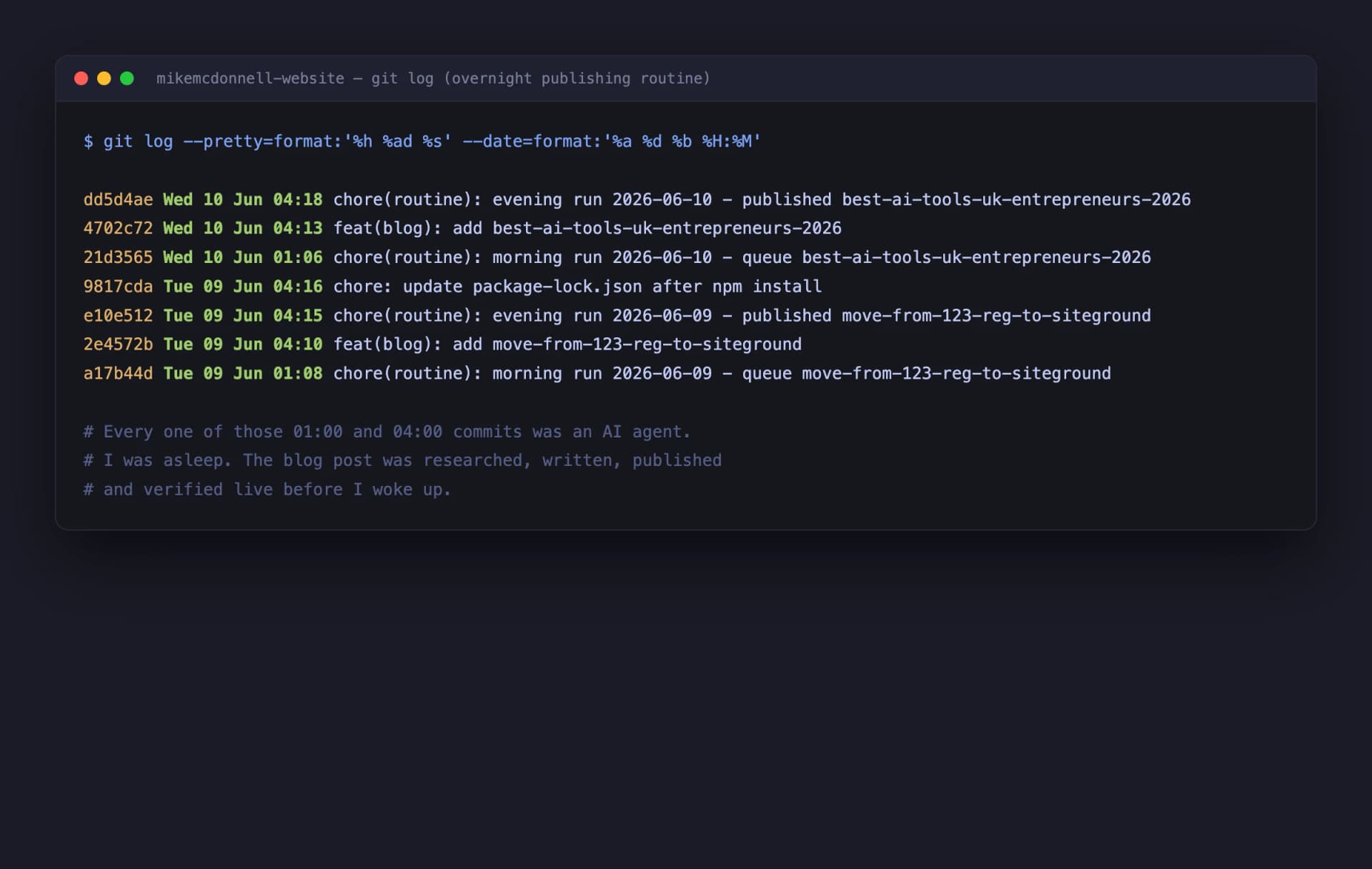
Here's the bit that matters if you're a founder thinking about hiring an agency. Last night, blog posts were researched, written, published and checked on one of my sites while I was asleep. I woke up at a normal time, made a coffee, and read what my business had done without me. That's not a stunt. It happens every night.
What AI-native means at Glide
There's a big difference between an agency that uses AI and an agency built around it.
Most agencies have added an AI writing assistant to the same old process. Same meetings, same handoffs, same six-week timelines, just slightly faster typing in the middle. Glide works the other way round. The production process is built for AI agents from the start, and humans sit at the points where judgement matters.
The main tool is Claude Code. It's a coding agent that works in the terminal, which means it can read an entire codebase, write and test changes, check live data and deploy, rather than just chatting. Around it sits a deliberately boring stack: Cursor and GitHub for code, Vercel for hosting, Next.js for the sites themselves, Supabase for data, Google Search Console and GA4 for results, Canva for design assets.
That stack matters more than it sounds. Everything is plain text, version controlled and readable by an agent. When your whole business runs on systems an agent can see, the agent can do real work in them, not just give you advice about them.
A small example. I used to pay for an off-the-shelf tool that sorted my inbox. I replaced it with an email agent I built myself with Claude. It reads every email that arrives, files it, and drafts a reply in my voice for me to check and send. It does the job better than the paid tool did, because it knows my business. And I own it, so there's no subscription quietly going up every year.
That's the pattern for everything at Glide. Don't buy a black box. Build a small, transparent agent on systems you already trust, let it draft, and keep a human on approval.
The five AI department heads
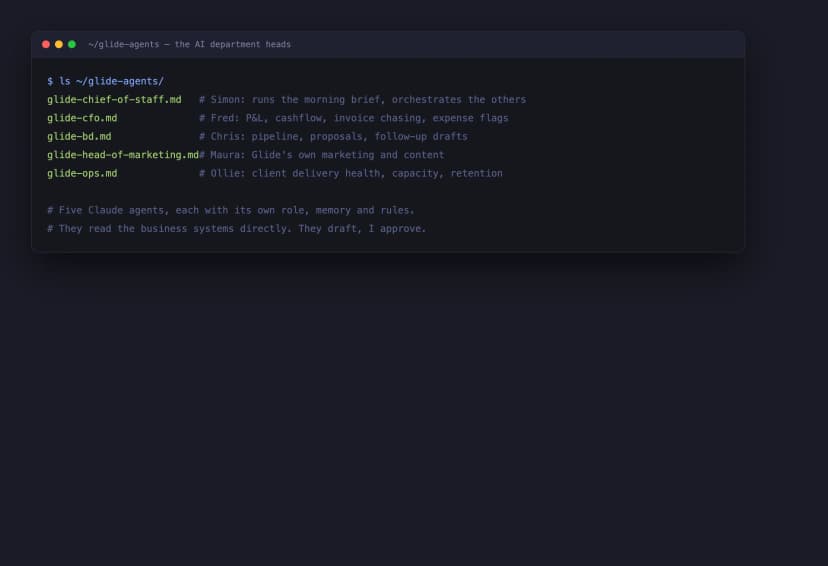
Glide's back office is run by five named AI agents. Naming them sounded like a gimmick to me at first. It isn't. Each one has a defined job, the context that job needs, and hard limits on what it can touch.
- Simon, Chief of Staff. Pulls everything together into a morning brief: what's moving, what's stuck, what needs a decision from me.
- Fred, CFO. Reads our finance data and flags unpaid invoices, cost creep and margin problems before they become real problems.
- Chris, BD. Watches the sales pipeline, reads meeting notes, and drafts follow-ups in my voice for me to approve.
- Maura, Head of Marketing. Runs Glide's own marketing, including the publishing engine you're reading the output of right now.
- Ollie, Ops. Tracks delivery health, client reporting and the boring operational stuff that usually slips at small agencies.
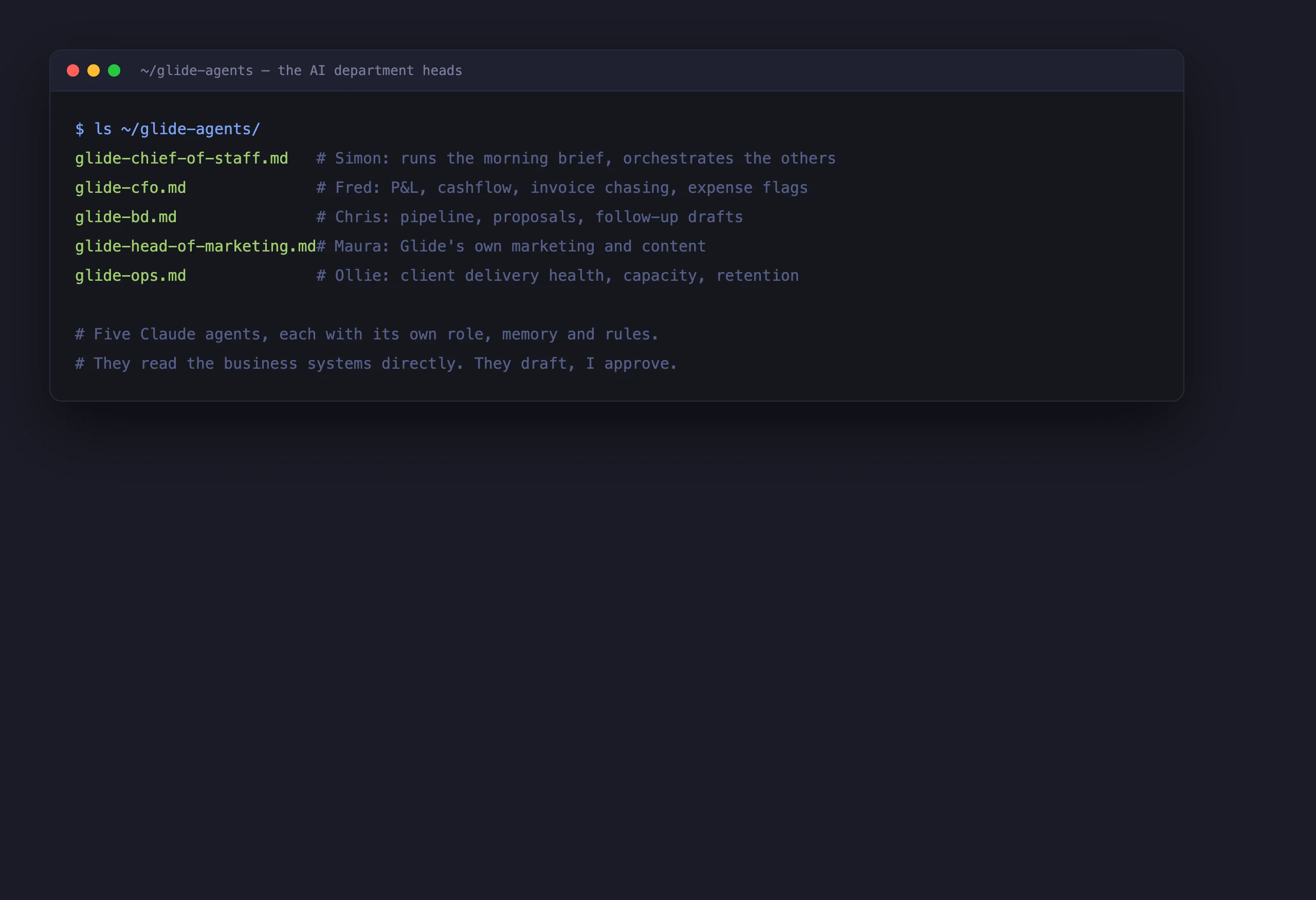
The rule that makes this safe is simple. They read, they prepare, they draft. They do not send. No email, invoice, post or piece of client work leaves this business without a human approving it, and that human is usually me.
And to be clear, the humans still matter most. Matt leads delivery and owns capacity. Abbie keeps the books straight. Amber runs social for clients. My job is direction, sales and sign-off. The agents exist so that none of us spend our days on admin, chasing and status updates. You can read more about the team and how we work.
The overnight publishing engine (with the receipts)
This is the part nobody else shows you, so here it is.
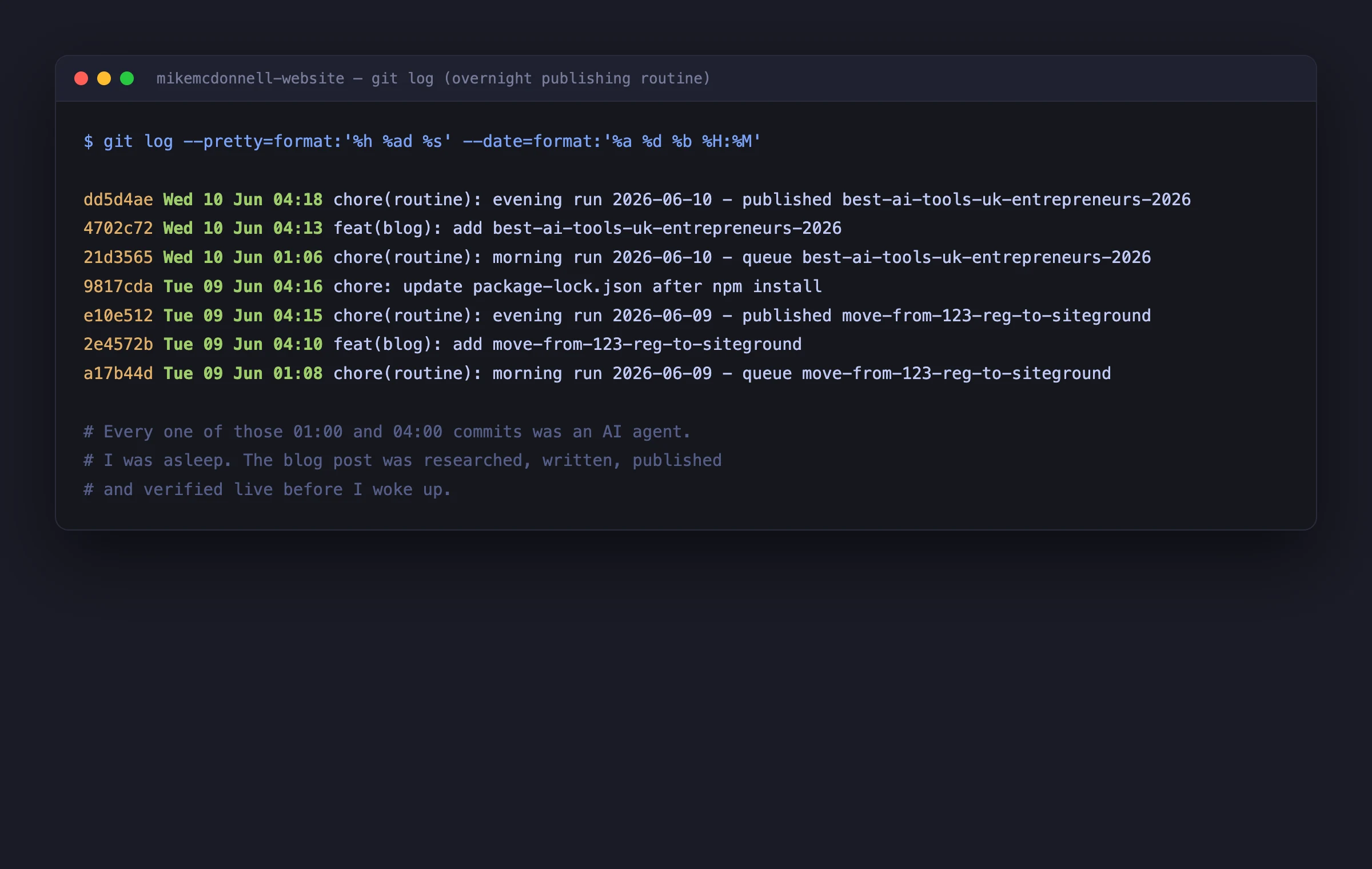
Twice a night, an agent wakes up on a schedule and runs a full publishing cycle on one of my sites. It picks the next topic from a plan we agreed in advance. It researches what already ranks for that topic and looks for the gap. It writes the post, commits the code to GitHub, and Vercel deploys it. Then comes the step most people skip: it loads the live page and checks its own work published properly. If anything breaks, it writes up the problem for me to read in the morning.
Those 1am and 4am timestamps aren't me grinding through the night. I was asleep. That's the whole point. The machine keeps the production line moving so the humans can live normal lives and spend their working hours on the things machines are bad at.
One thing I want to be straight about, because AI content has a deserved reputation problem. This is not churn-and-burn filler. Every guide on this blog is written from real client work, and there's a named human accountable for every word. The agents draft from real data and real experience, and the bar for publishing is the same as if I'd typed it myself.
What stays human, and why
If AI did everything, I'd be out of a job and you'd have no reason to hire Glide over a prompt. So here's the honest split.
Strategy stays human. AI can't sit in your scoping call. It doesn't know that your best customers come from word of mouth, that your old agency burned you, or that your busy season starts in March. I scope every project myself, and the plan we build comes out of what you tell us, not a template.
Quality control stays human. AI is a brilliant producer and a poor judge. It will happily produce something that is 90 per cent right and completely confident about the broken 10 per cent. Every page, post and design gets human eyes before a client sees it. At Glide that's me or Matt, not a junior ticking a box.
Accountability stays human. When you hire Glide, a named person answers for the work. If something goes wrong, you call me and I fix it. An AI agent can't be accountable, and any agency that hides behind "the AI did it" doesn't deserve your money.
The way I think about it: AI raised the floor on production, so the value moved to judgement. The agencies that win from here won't be the ones with the most tools. They'll be the ones with the best taste and the clearest accountability sitting on top of an AI production line.
What this means for you as a client
You might be reading this thinking, interesting, but I just want a website that brings in work. Fair. Here's what the AI-native setup changes on your side of the table.
Speed. Production that used to take weeks takes days. A first draft of a site appears fast, which means more of the project is spent refining the thing you'll launch instead of waiting for it.
Price. When production costs fall, prices can too. It's why website design here does not start with a scary one-off build quote. You're paying for senior judgement and a result, not for a building in Shoreditch and six people in the meeting.
Senior attention. Because agents handle the admin and the heavy production, the humans you deal with are the senior ones. No account managers relaying messages, no juniors learning on your budget.
Proof, not promises. Everything we do is measured in Google Search Console and GA4, and the same agents that run our back office prepare the reporting, so you see what's working without paying for report-writing time. I've written before about what SEO costs in the UK if you want the honest numbers side of this.
The honest limits of AI
I'd be lying if I told you this all runs itself perfectly. It doesn't, and you should be suspicious of anyone who says theirs does.
AI gets things confidently wrong. It will state a wrong fact with the same calm tone it states a right one, which is exactly why the human QA layer exists and will keep existing. It has no taste of its own. Left without direction, it drifts towards the average of everything on the internet, and the average of the internet is mediocre. The voice, the standards and the strategy have to come from a person.
It also doesn't know your business until someone teaches it. The agents at Glide are useful because they've been given years of real context: our clients, our numbers, our voice, our mistakes. A fresh AI tool with none of that is just a fast typist.
And some things it simply shouldn't do. It never sends anything external on its own, never touches money, and never publishes client work without sign-off. Those aren't technical limits. They're rules I set, because the approval layer is the product, not a weakness in it.
The short version
Glide is a small Essex agency where AI agents do the production and the admin, and humans do the thinking, the checking and the relationships. The result is work that ships faster, costs less than the traditional model, and still has a senior human's name on it.
If you want a website and SEO partner whose production line runs while everyone sleeps, with a real person accountable at the top of it, tell us what you need. The first reply is from me, not a bot, and you'll get a straight answer on whether we're the right fit.
Mike McDonnell, Founder of Glide Marketing. More about how I work.
Frequently asked questions
What is an AI marketing agency?
An AI marketing agency builds its delivery process around AI rather than bolting a few tools onto an old workflow. At Glide, AI agents handle production work like drafting, publishing and reporting, while humans own strategy, quality control and client relationships.
Does AI write everything at Glide?
AI drafts most of the production work, including blog content and code. Nothing client-facing goes out without a human reviewing it and signing it off, usually Mike. Strategy and quality control always stay human.
Is AI-written content bad for SEO?
Google rewards helpful content and penalises thin content, however it was produced. Mass-produced filler fails whether a human or a machine typed it. Researched, fact-checked, human-reviewed content performs, and that is the standard every post here is held to.
What AI tools does Glide use?
The main one is Claude Code, a coding agent that works in the terminal. Around it sit Cursor, GitHub, Vercel, Next.js, Supabase, Google Search Console, GA4 and Canva. We build our own agents on top of those systems rather than buying off-the-shelf AI products.
Will I be dealing with a human or a bot?
A human, every time. Mike scopes every project himself and Matt leads delivery. The AI works behind the scenes on production. Clients are never handed to a chatbot.
Does using AI make an agency cheaper?
It cuts production time dramatically, which is why Glide does not need to charge a large one-off build fee. You still pay for human judgement. You stop paying for human typing speed.
Can AI replace a marketing agency completely?
Not well. AI produces quickly but judges poorly. It cannot set strategy for a business it has never met, it cannot sit in a scoping call, and it cannot be accountable when something goes wrong. The agencies that win will pair AI production with senior human judgement.