How We Run Glide on AI
An honest look inside an AI-native agency: the agents, the overnight publishing, what stays human, and the receipts to back it all up. No buzzwords, no stock-photo robots, just how the agency works.
Most agencies did the same thing when AI arrived. They took the operation they were already running in 2019, bolted a chatbot onto the contact page, mentioned ChatGPT in the pitch deck, and relabelled themselves “AI-powered”. The timelines didn't change. The prices didn't change. The same overstretched account manager was still juggling the same ten clients, just with a new line in the footer.
We went the other way at Glide. Instead of adding AI around the edges, we rebuilt the production line itself. AI agents do the heavy lifting: research, first drafts, website builds, reporting, monitoring, and the overnight publishing runs. Humans do the things that genuinely need a human: strategy, quality control, client relationships, and accountability when something matters. Nothing reaches a client without a person signing it off, and that person is usually me.
This page is the hub for the full story. The five posts below cover how the whole operation works, who the agents are, what AI speed means for your website build, and the honest list of things we still don't trust AI to do. Everything in them is real: actual commit logs, actual builds shipped for actual clients, and the actual tools named. Nothing hypothetical, nothing borrowed from someone else's LinkedIn post.
Why publish any of this? Two reasons. If you're about to trust an agency with your website and your search visibility, you deserve to know how the thing you're buying gets made. And the way we work is the single biggest reason we can deliver faster, and charge less than a five-figure build fee, while agencies running the 2019 playbook cannot.
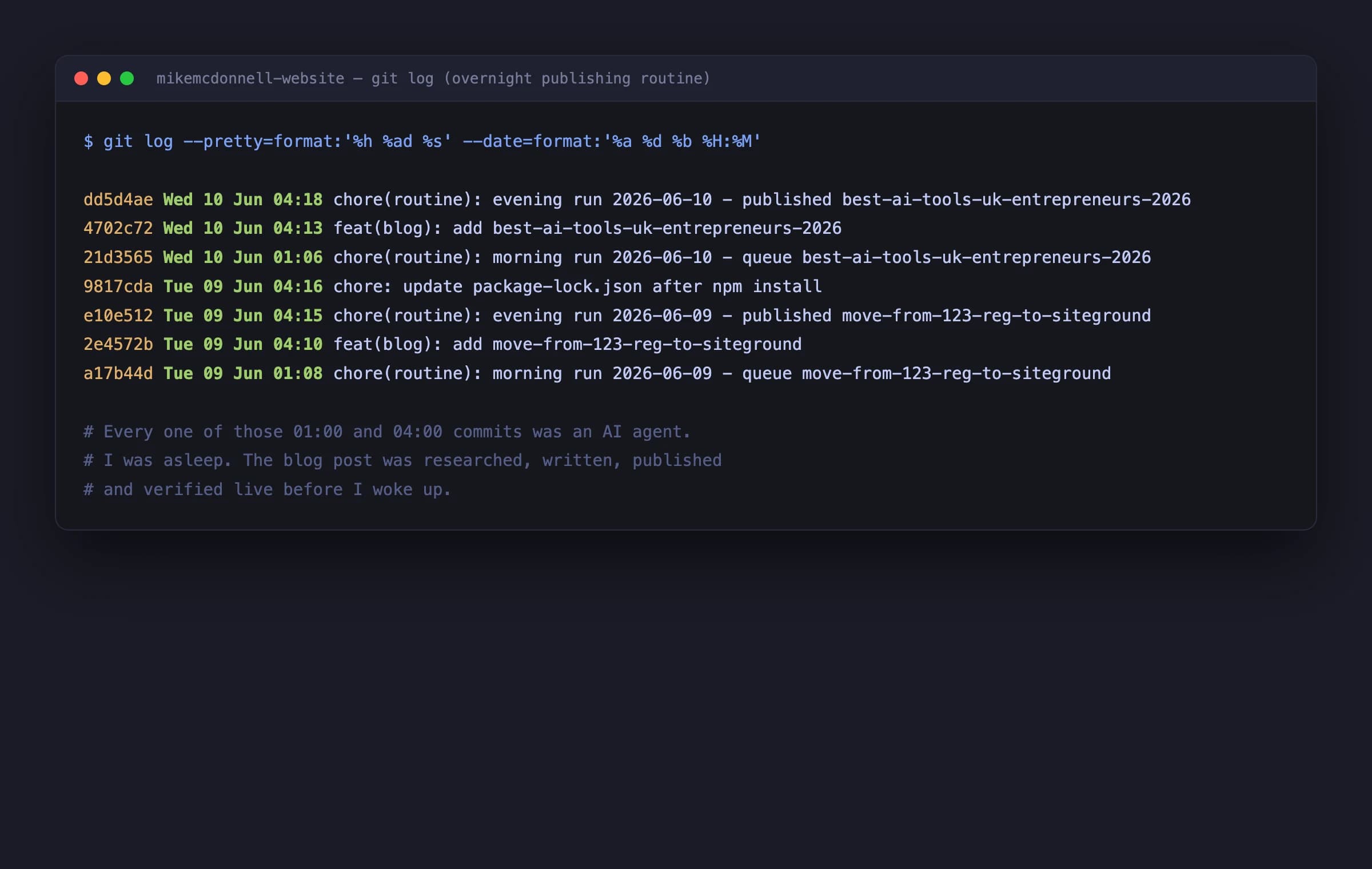
A real git log from one of our projects. Those overnight commits are AI agents researching, writing and publishing while I was asleep. This is what the production line looks like when nobody is watching it.
I lead with this screenshot because claims about AI are cheap right now. Everyone says they use it. Almost nobody shows you the evidence. So every post in this series leans on receipts: real logs, real dashboards, real builds you can visit. If a claim can't be backed up with something you can see, it doesn't go in.
Who does the work
Glide runs on five AI department heads plus a small human team. The agents cover Chief of Staff, Business Development, Marketing, Finance and Operations. Each one has its own remit, its own memory, and its own scheduled runs. While I sleep, they fan out across the business: the finance agent reconciles the numbers, the marketing agent drafts and publishes content, the ops agent checks client sites are healthy, and the chief of staff pulls it all together into a brief that's sitting in my inbox before 6am. I read it over coffee and make the decisions that need a human.
The humans sit on top of that. I set direction, handle sales and own every client relationship. Matt leads delivery and quality. Nothing an agent produces goes anywhere near a client without one of us reviewing it first. That rule is not negotiable, and the fourth post below explains exactly why.
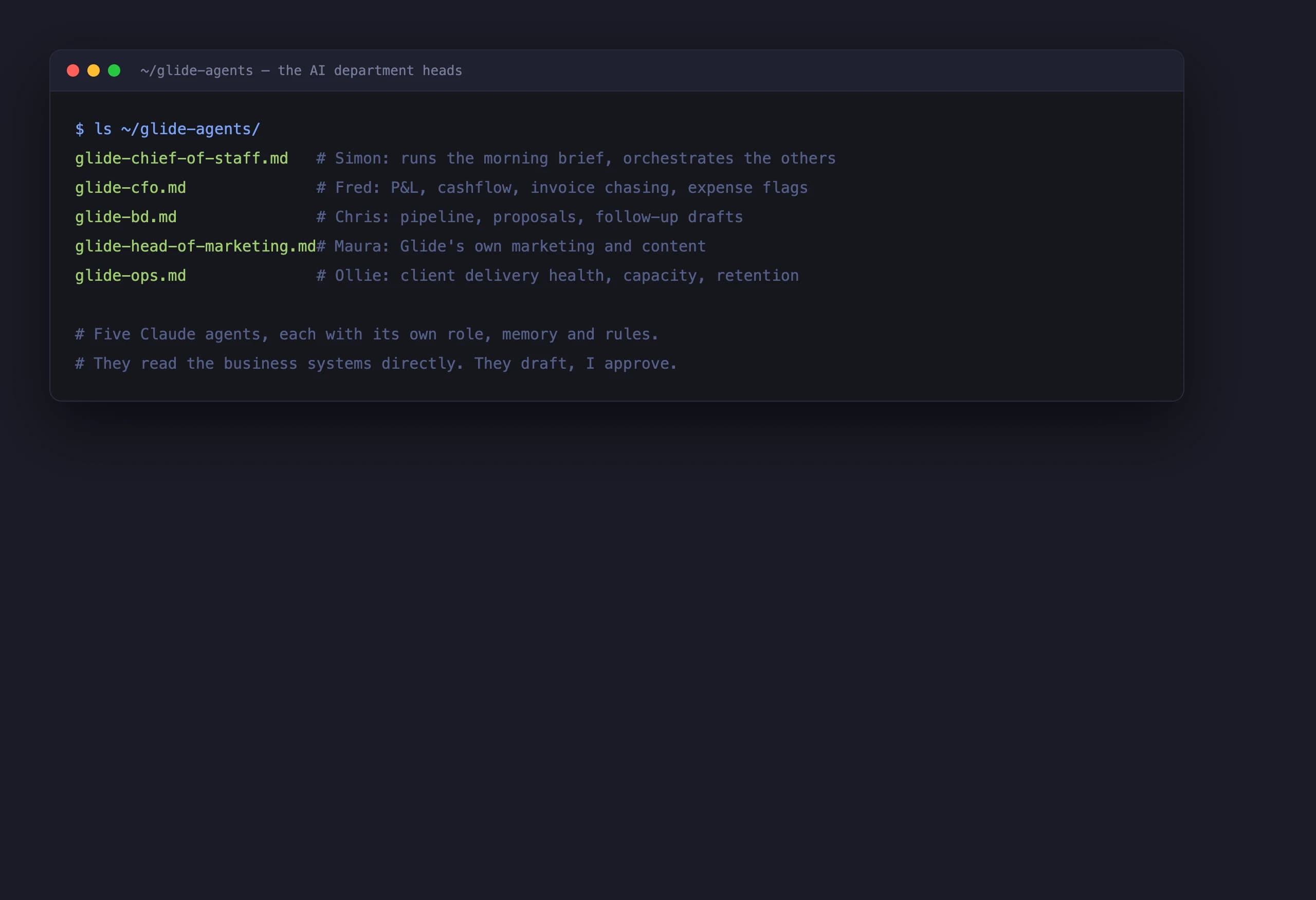
The agent roster. Five departments, each with its own remit, memory and overnight schedule.
None of this appeared overnight, ironically. It took months of building, breaking and correcting. The important part is the feedback loop: every time an agent gets something wrong, the correction gets written into its memory, so the same mistake doesn't happen twice. The operation gets a little sharper every single week, which is something you can't say about most agency processes.
The other principle that makes it work is legibility. Everything the agents do gets recorded: every decision, every draft, every published page sits in a log a human can read. That's why I can review a whole night's work in twenty minutes over coffee, and it's why mistakes get caught before a client ever sees them rather than three weeks later in a report.
What stays human
The fastest way to lose your trust would be to pretend AI does everything here. It doesn't, and I wouldn't want it to. There's a line we hold, and it doesn't move:
- Strategy and positioning. Deciding what your business should say, who it should target and where it should compete is judgement work. A human does it.
- Client relationships. You will never be account-managed by a bot. Calls, emails and awkward conversations are handled by me or Matt.
- Pricing, promises and scope. Nothing gets quoted or committed to without a human signing it off. An agent cannot promise you anything.
- Final quality control. Every page, post and build gets human eyes before it ships. That's the accountability you're paying for.
The fourth post in the series goes much deeper on this, including the failures that taught us where the line belongs.
The full story, post by post
Five posts, written in order, covering the whole operation. Start with the flagship if you want the big picture, or jump straight to the one that answers your question.
The flagship
How I Run a Marketing Agency on AI
The full breakdown of the operating system: the tools we use, how the agents are wired together, what a normal week looks like, and what it costs to run. If you only read one of these, read this one.
Read the post →Meet the team
The Agents That Work While I Sleep
The five AI department heads: who they are, what each one owns, and what was waiting in my inbox this morning while I was still asleep. Includes the real overnight schedule.
Read the post →For buyers
Websites in Days, Not Months
What AI speed means for your build: how a website goes from kickoff call to live in days rather than months, without cutting corners on design, copy or SEO.
Read the post →The honest one
What AI Can’t Do
The list of things we never hand to AI, why a senior human stays accountable for every piece of work that reaches a client, and what that guarantee means for you.
Read the post →The walkthrough
How We Run Glide Marketing With AI Agents
A practical walkthrough of the AI agents running inside Glide: what each one does, which tasks stay human, a real example of building a blog post, and what this means if you are hiring an agency.
Read the post →What this means if you hire us
All of the above is interesting if you like this sort of thing. But if you're a founder weighing up agencies, here's what it changes for you.
Faster delivery, without the corner-cutting. A website that would sit in a traditional agency's queue for three months gets designed, written and built here in days. Not because we rush, but because the production work happens in parallel and around the clock. You spend the saved time reviewing and refining, which is where a client's input is genuinely valuable.
A fair price instead of a five-figure build. When the production cost drops, the price should too. You are not gambling thousands up front on an agency you have just met. You get your figure in writing on the first call, in plain English, with nothing hidden behind a discovery call. See what we do.
Senior humans on every account. Because the agents handle the production grind, the humans you deal with aren't juniors learning on your budget. You talk to me or to Matt, the people who set the strategy and check the work. Most agencies can't afford that structure. Ours is built for it.
Proven AI-search expertise, not just claims. Running an agency on AI also means we understand how AI search engines read websites, because we live in that world every day. One of our clients has been cited over 1,200 times in Microsoft Copilot answers, and we build every client site to earn the same kind of visibility. The full breakdown is in our guide to AI search optimisation.
One honest caveat to finish on: AI hasn't made agencies obsolete, and it hasn't made judgement optional. It has made the production side of this industry dramatically cheaper and faster, and the agencies that admit that, and pass the benefit on to their clients, are the ones worth hiring. That's the bet we've made with Glide. The posts above show our working.
Want this working for your business?
Tell me what you need and I’ll walk you through what an AI-native agency can do for your website, your search visibility and your sanity.
Tell us what you're working on
Fill in the form and tell us what you're trying to achieve, who you're going after and what you can spend. Mike reads every one and comes back with a straight answer on whether we can help.
Tell us about your projectTakes two minutes. No calls, no diary tennis. A reply within one working day.