How We Run Glide Marketing With AI Agents (What They Do, What They Do Not)
A plain-English walkthrough of the AI agents running inside Glide Marketing: what each one does, which tasks stay human, and what this means for Essex businesses hiring an agency.
Key Takeaways
- AI agents at Glide handle production work: drafting, research, code, and publishing. Humans own strategy, quality control, and client relationships.
- Every piece of client-facing work is reviewed by a person before it ships. That rule has no exceptions.
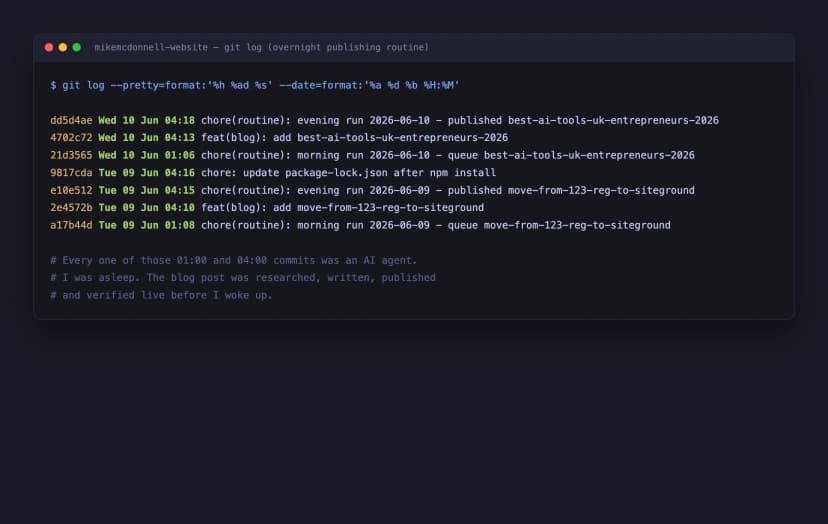
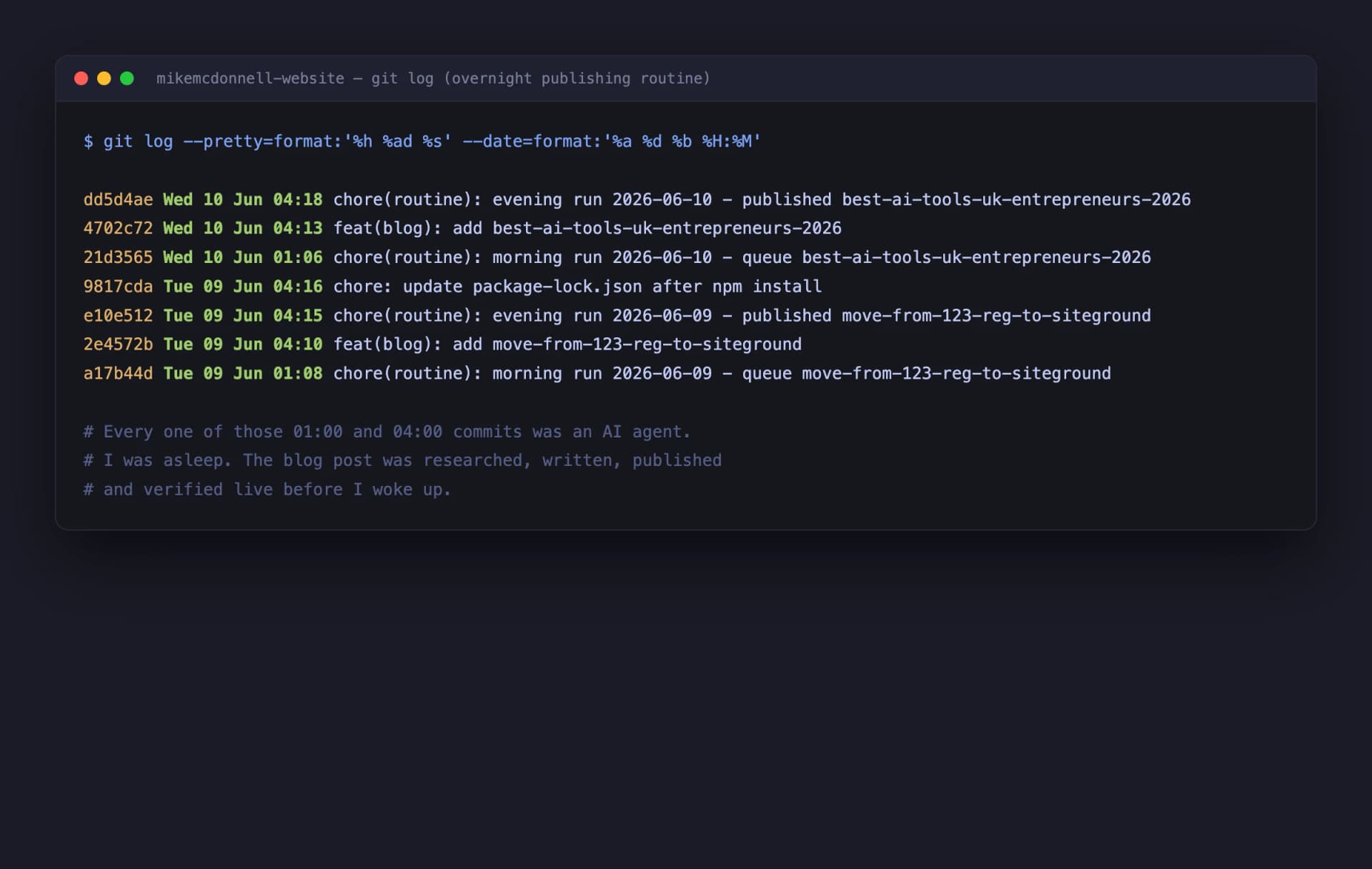
- The agents run overnight. Blog posts are researched, written, published and verified while the team sleeps.
- This is why Glide does not need a five-figure upfront build fee. AI cuts the production cost. Human judgement is what you pay for.
- If you are an Essex business owner, the practical takeaway is this: the agency model is changing fast. Find one that is honest about what AI does and does not do.
I wrote a post earlier this week called How I Run a Marketing Agency on AI. That one covered the broad picture: the five named agents, the overnight publishing routine, where AI fits and where it does not. This post goes deeper. It is the practical walkthrough. If you are a business owner trying to understand what AI-native looks like inside a small agency, this is the version for you.
What an AI agent is
Forget the sci-fi. An AI agent at Glide is just a program that runs a set of tasks I would otherwise do myself. It reads instructions, searches the web for context, writes a draft, checks its own work against a quality list, and hands the result to me for review. It does not have opinions. It does not make strategic decisions. It does not call a client.
Think of it like a very fast, very thorough junior team member who works through the night and leaves everything on your desk by morning. You still decide what ships and what gets rewritten.
The agents running inside Glide right now
There are a few different agents doing different jobs. Here is what each one does, without the jargon.
Content agent. This one researches a topic, pulls together the facts, drafts a blog post or service page, and checks it against our style rules. It searches the web for real data rather than making things up. By the time I see the draft, it has already been through a quality checklist: no banned words, UK English, internal links present, facts cross-checked. I read it, I edit where needed, and I publish. The agent does the heavy lifting. I do the thinking.
Development agent. This one writes code. It builds new pages, updates the sitemap, fixes bugs, and commits to GitHub. The commit log on this site shows the timestamps. Some commits come in at 1am. That is the agent working. The next morning I review the diff, run the TypeScript check, and merge to main. Nothing deploys without that step.
SEO audit agent. This one crawls client sites, checks for technical issues, compares against competitors, and produces a prioritised fix list. It uses Google Search Console data where the client has connected it. The output is a report I can hand to a client after about ten minutes of review and annotation, rather than a day of manual checking.
These are not separate pieces of software we bought. They are workflows we built on top of the tools we already use: Claude Code, GitHub, Vercel, Next.js, Supabase, Google Search Console, GA4 and Canva. The agents are the process layer between those tools.
What the agents do not touch
This matters more than what they do. There is a clear line, and it does not move.
Strategy. The agents do not decide what a client needs. They do not write a growth plan. They do not choose which keywords to target or which services to push. That is all human work, done by me from what the client tells us and refined over time as we see what works.
Client relationships. The agents never speak to a client. They do not send emails, they do not take calls, they do not join meetings. Matt runs delivery day to day. I stay accountable for strategy and sign-off. The client experience is entirely human.
Quality control. Every piece of work the agents produce is reviewed by a person before it reaches a client. Code gets a diff review. Content gets read and edited. SEO reports get annotated with context the agent cannot know, like what the client told us on a call last week.
A real example: building this blog post
This post was drafted by the content agent. The process looked like this:
The agent searched for current discussions about AI marketing agencies, pulled in facts from the existing AI posts on this site so it did not contradict anything, and drafted a structure that covered the gaps those posts left open. It wrote the first draft, checked it against our style rules (UK English, no em dashes, no banned words, internal links where they make sense), and handed it to me.
I read it. I moved a few paragraphs around. I sharpened a couple of sentences that sounded too much like a press release. Then I published it. Total human time: about fifteen minutes. Without the agent, this post would have taken two to three hours.
That time difference is the whole business model. It is why we do not need to send a four-figure invoice before the work starts. It is why a small team in Chelmsford can compete with agencies that have twenty people. The production cost is near zero. The value is in the judgement.
What this means if you are hiring an agency
AI is changing how agencies work whether you can see it or not. The question is not whether an agency uses AI. The question is whether they are honest about it and whether they have their quality controls in the right place.
Here is what to look for:
Transparency. If an agency will not tell you how they use AI, assume they are either hiding something or using it badly. A good agency will tell you exactly what is automated and what stays human.
Human accountability. Ask who signs off the work. If the answer is vague, that is a problem. At Glide, I sign off every build and every piece of content. That is not a marketing line. It is how we work.
Pricing that makes sense. If an agency charges the same as they did in 2022 while claiming to be AI-native, something does not add up. AI should make delivery faster and cheaper. If the price has not moved, either the AI is not doing much, or the savings are not reaching you.
Where this goes next
I am honest about the limitations. The agents get things wrong. Sometimes they miss context that a human would catch straight away. Sometimes they produce work that is technically correct but reads like a robot wrote it. The quality checklist catches most of it, but not all. That is why the human review step is not optional.
Over the next year, the agents will get better. They will handle more of the repetitive work. They will catch more of their own mistakes. But the core model will not change: AI does the production, humans do the judgement. That is the only version of an AI agency I am interested in building.
Frequently asked questions
Do you really run your agency with AI agents?
Yes. Agents handle production work like drafting, research, code generation and publishing. Every piece of work is reviewed by a human before it goes anywhere near a client. The agents speed up the doing. The humans own the deciding.
What AI tools does Glide use day to day?
Claude Code for development and content production, Cursor as the coding editor, GitHub for version control, Vercel for hosting, Next.js as the framework, Supabase for database work, Google Search Console and GA4 for reporting, and Canva for design. We build our own agent workflows on top of these rather than buying an off-the-shelf AI product that does not know our clients or our standards.
Can an AI agent replace a marketing agency?
Not well. AI can produce quickly but it cannot set strategy for a business it has never met, sit in a scoping call with a founder, or be accountable when a decision needs to be made. The agencies that will do best in the next few years are the ones that pair AI production speed with senior human judgement.
Does using AI make your agency cheaper?
It cuts production time, which means there is no large upfront build fee to charge. You are still paying for human judgement and accountability. You stop paying for human typing speed.
Is AI-generated content bad for SEO?
Google cares about helpfulness, not about which tool produced the words. Mass-produced filler fails whether a human or a machine wrote it. Researched, fact-checked, human-reviewed content performs. That is the standard every post on this site is held to.
Mike McDonnell is the founder of Glide Marketing, a small agency in Chelmsford, Essex that builds websites, runs SEO and handles ongoing growth for UK service businesses. He writes about AI, agency life and what works in search. More about Mike.
Frequently asked questions
Do you really run your agency with AI agents?
Yes. Agents handle production work like drafting, research, code generation and publishing. Every piece of work is reviewed by a human before it goes anywhere near a client. The agents speed up the doing. The humans own the deciding.
What AI tools does Glide use day to day?
Claude Code for development and content production, Cursor as the coding editor, GitHub for version control, Vercel for hosting, Next.js as the framework, Supabase for database work, Google Search Console and GA4 for reporting, and Canva for design. We build our own agent workflows on top of these rather than buying an off-the-shelf AI product that does not know our clients or our standards.
Can an AI agent replace a marketing agency?
Not well. AI can produce quickly but it cannot set strategy for a business it has never met, sit in a scoping call with a founder, or be accountable when a decision needs to be made. The agencies that will do best in the next few years are the ones that pair AI production speed with senior human judgement.
Does using AI make your agency cheaper?
It cuts production time, which means there is no large upfront build fee to charge. You are still paying for human judgement and accountability. You stop paying for human typing speed.
Is AI-generated content bad for SEO?
Google cares about helpfulness, not about which tool produced the words. Mass-produced filler fails whether a human or a machine wrote it. Researched, fact-checked, human-reviewed content performs. That is the standard every post on this site is held to.