Subscription Web Design: Why We Charge Monthly
The honest case for subscription web design: Glide's £150 and £350 monthly plans, the real 3 year maths, and when paying monthly is the wrong call.
Key Takeaways
- Subscription web design means paying monthly (£150 or £350 at Glide) instead of a £5k to £15k upfront invoice. The build, hosting, maintenance and ongoing SEO foundations are all included.
- The real advantage is the incentive flip: an agency paid monthly has to keep earning your money. An agency paid upfront already has it.
- Honest maths: over 3 years a £350 a month plan can cost more than a one-off build. You are buying cashflow, zero upfront risk and continuous improvement, not a discount.
- Subscription is the wrong choice if you have in-house developers, want full ownership from day one and have the capital, or your site never changes.
- The dirty secret of cheap pay monthly mills: many own your site and sometimes your domain forever. Always ask about ownership and exit cost before signing anything.
- Glide publishes a one-off buyout option. You can leave with everything, any time. That is the test any honest subscription provider should pass.
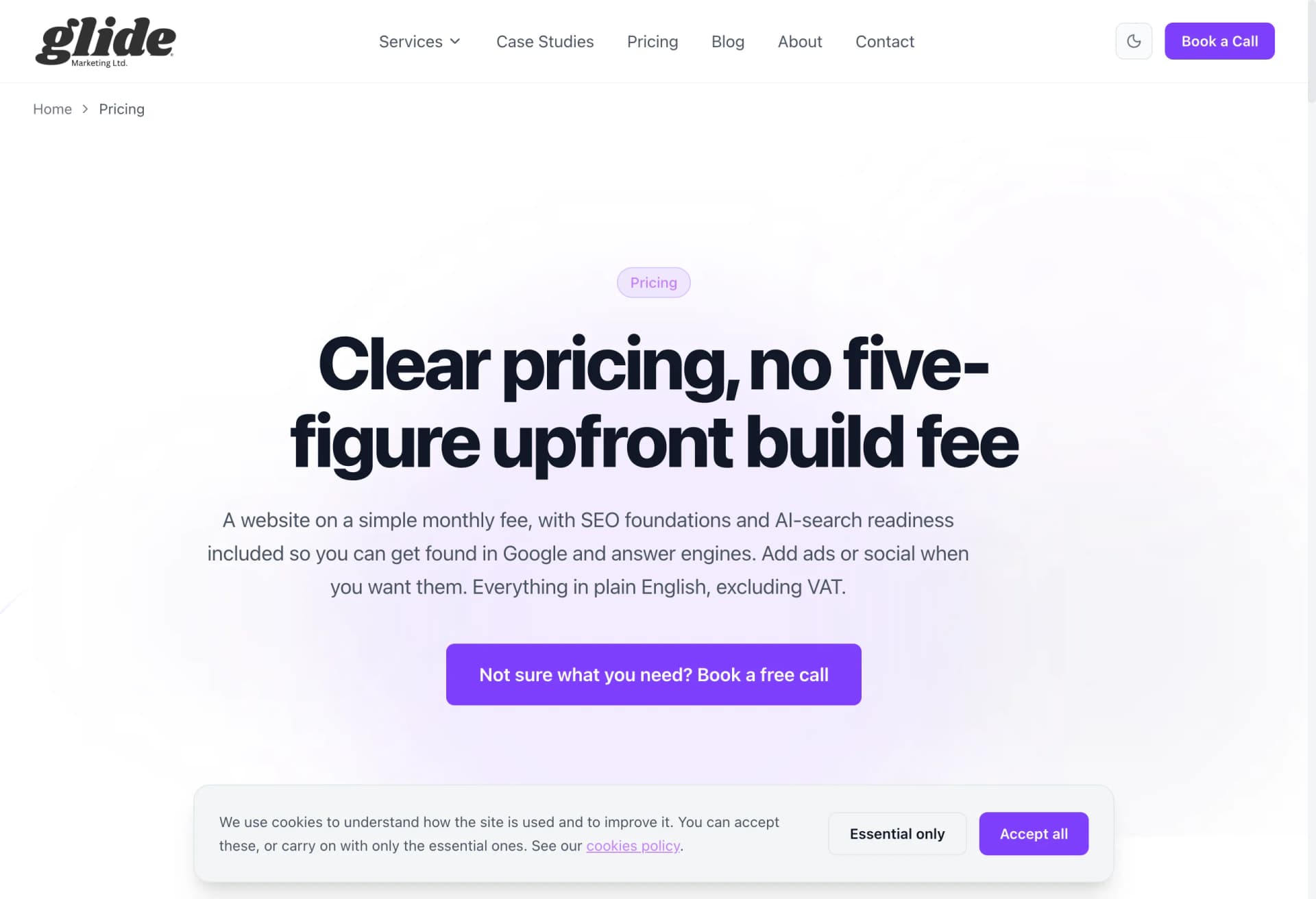
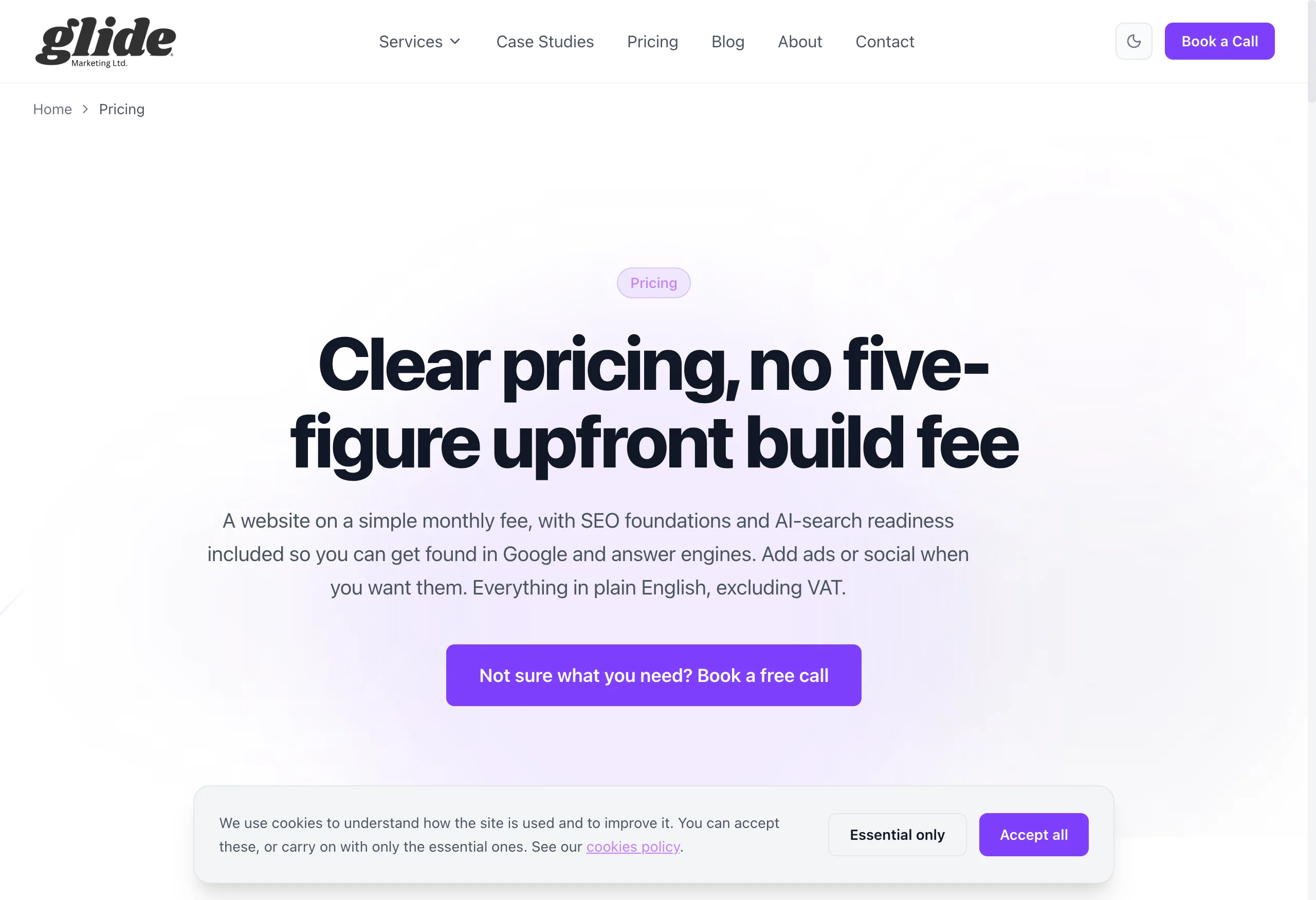
I charge monthly for websites. £150 a month for our Lite plan, £350 a month for Growth, both on our public pricing page. No five-figure invoice, no deposit, no "investment starts from" mystery pricing.
I am going to explain why, and I am also going to do something most pay monthly website companies will not: tell you when this model is the wrong choice for you. Because it sometimes is, and pretending otherwise is exactly the kind of sales fluff this post exists to cut through.
The problem with the big upfront quote
Picture the standard agency process. You have a call, they go quiet for a week, then a PDF lands in your inbox: £6,000 for a new website. Sometimes £10,000. Sometimes more.
Here is what that invoice asks of you. Pay thousands of pounds, now, for something you cannot see yet. You are trusting a portfolio, a sales call and a mood board. If the site turns out mediocre, you have already paid. If the agency drags the project out for five months, you have already paid. If it launches and then quietly breaks a year later, that is a new invoice.
The risk sits entirely with you. Agencies know this, which is why so many of them ghost-proof the deal with 50% deposits and staged payments. They have been burned by clients walking, so they front-load the money. Completely rational from their side. Terrible from yours.
I know this dance from the other side of the table. In Glide's early days I sent out big one-off quotes and watched perfectly warm leads simply vanish. Not "no thanks". Nothing. Ghosted. Eventually I worked out the obvious: the quote was the problem. A few thousand pounds upfront for an invisible future website is a genuinely scary purchase for a small business, and scared buyers do not reply to emails. They disappear.
So I changed the model instead of blaming the buyers. If you want the full breakdown of what UK websites cost across every pricing model, I wrote a separate guide on website costs. This post is about the monthly version specifically.
How subscription web design works
Simple version: the build is included, and the monthly fee covers everything that keeps a website alive and improving.
At Glide, both plans include the design and build of the site, hosting, security and maintenance, and ongoing SEO foundations: proper page structure, schema markup, Search Console monitoring, the technical groundwork that decides whether Google ever sends you anyone. Growth gets you a bigger site and more improvement work each month than Lite. Google Ads management is separate, from £500 a month, because ads are a genuinely different job.
You can see exactly how we approach the build side on our web design page, but the model matters more than the deliverables list. Here is the bit I think most people miss.
Subscription flips the incentives. An agency paid £6,000 upfront got paid already. Whatever happens after launch, they have your money. Their financial incentive to care about your site in month 14 is roughly zero, which is why so many websites launch well and then rot.
An agency paid monthly is in a completely different position. If your site breaks, slows down or slides out of Google, you cancel, and they lose the income. They have to keep earning it, every single month. I did not design that pressure as a marketing line. I designed it because I wanted clients to stay because the work is good, not because a contract traps them.
The honest maths over 3 years
Most pay monthly websites pages skip this section, or rig it. Let me do it properly.
Take our Growth plan at £350 a month and compare it with a decent £6,000 one-off build over 3 years.
- Growth subscription: £350 x 36 months = £12,600.
- One-off build: £6,000 build + roughly £900 of hosting over 3 years + ad-hoc maintenance and fixes, call it £2,500 if you are sensible about updates = roughly £9,400.
So over 3 years, the subscription costs about £3,000 more. I am not going to pretend otherwise. If the only thing you are comparing is the total spent, a one-off build can win over long horizons, and any provider who hides that is rigging the comparison.
What the subscription buys you is three things the one-off build does not include:
Cashflow. £350 a month is a line in your budget. £6,000 is a lump that, for most small businesses, comes out of money earmarked for something else. Plenty of good businesses can afford £350 a month and genuinely cannot afford £6,000 this quarter.
Zero upfront risk. You are not betting thousands on an unseen result. If the work is bad, you stop paying. The agency carries the risk of the build, which is exactly where it belongs, because the agency controls the quality.
Continuous improvement. The £6,000 site is frozen on launch day. The subscription site gets maintained, updated and improved every month, including the ongoing SEO foundations that compound over time. By year 3 you are not comparing two versions of the same site. One has been worked on for 36 months and one has not.
And for completeness: our Lite plan at £150 a month is £5,400 over 3 years, which is less than the £6,000 build before you have even added hosting. At the smaller end, the subscription simply wins on raw cost too.
When subscription web design is wrong for you
Here is the section nobody else writes. I checked the top-ranking pay monthly website pages before writing this, and not one of them tells you when their own model is a bad fit. So, plainly:
You have in-house developers. If someone on your payroll can build and maintain the site, paying an agency monthly for maintenance is paying twice. Buy a one-off build, or build internally, and spend the monthly budget elsewhere.
You want to own everything from day one and have the capital. Some owners just sleep better owning the asset outright, and if the lump sum is not painful for you, that is a completely legitimate choice. Pay once, own it, done.
Your site genuinely never changes. A five-page site for a business that gets all its work from word of mouth, never publishes anything and does not care about Google does not need monthly attention. Paying for ongoing improvement you will never use is waste, whoever you pay it to.
If you sit in any of those three groups, I would rather tell you now than take your direct debit for two years. A one-off build is the better deal for you. The rest of this post is for everyone else.
The lock-in question
Now the uncomfortable bit about my side of the market.
The cheap end of pay monthly web design, the £19 to £50 a month mills, mostly runs on one quiet trick: you never own the site. The design is theirs. The platform is theirs. Sometimes the domain is registered in their name. Cancel, and your website simply ceases to exist. Several of the big names also run 24 month minimum contracts where leaving early means paying every remaining month as a "settlement figure", like a phone contract with none of the consumer protection.
That is how a £30 a month website makes money. It is not really a website subscription. It is a rental with a very sticky landlord.
Glide's answer to this is a published buyout option. At any point, you can pay a clear one-off figure and take the whole thing in-house: code, design, content and domain. No negotiation, no hostage situation, no surprise exit invoice. If I am not earning the monthly fee, you should be able to leave with everything, and the buyout price is on the table from day one so you can check I mean it.
I would rather lose a client cleanly than keep one through a contract clause. Clients who stay because they are trapped tell everyone they know. Clients who stay because the work is good also tell everyone they know, and that referral engine is worth more than any settlement figure.
What to ask any pay monthly provider
Including us. Put these questions to anyone quoting you a monthly website, and watch how comfortably they answer:
- Who owns the domain? It must be registered in your name, full stop. If it is in theirs, walk away today.
- Who owns the design and the content? If you cancel, what do you keep?
- What is the exit cost? Is there a minimum term? A settlement figure? A buyout price? Is it written down anywhere public?
- What does "maintenance" include each month? "Hosting and updates" can mean real ongoing work or it can mean a server humming in a cupboard. Ask for specifics: what was done on a real client site last month?
- What happens to my Google rankings if I leave? If the site lives on their proprietary platform, the honest answer is often "you start again", and they will not volunteer that.
The pattern in the answers matters more than any single answer. Honest providers respond in specifics and put things in writing. The other kind change the subject to how affordable it all is. I wrote a longer set of vetting questions in my guide on how to choose an agency without getting burned, and most of it applies word for word here.
Why AI made this model possible
One last bit of honesty: I could not have offered these prices five years ago, and neither could anyone else doing real custom work.
A subscription model only works if the build cost is small enough to recover over the life of the plan. When a website took an agency 200 human hours, the only way to fund it was a big upfront invoice or a brutal lock-in contract. That is precisely why the cheap mills own your site: the lock-in is how they recover the build cost.
AI changed the production economics. We build sites in days rather than months, with AI doing the heavy production work and humans doing the strategy, design judgement and quality control. I wrote up exactly how that process works in how we build websites in days. The short version: when the build costs a fraction of what it used to, you can include it in a fair monthly fee and offer a clean buyout, no traps required.
That is the whole model. Cheap enough to start because AI compressed the build. Honest enough to stay because you can leave with everything whenever you like. And monthly because I would rather have to earn your money every month than take it all upfront and hope you never call.
The plans, the prices and the buyout option are all on the pricing page. Compare them against whatever quote is sitting in your inbox. If a one-off build genuinely suits you better, I will tell you that on the call too.
Mike McDonnell, Founder of Glide Marketing. More about how I work.
Frequently asked questions
What is subscription web design?
Instead of paying a few thousand pounds upfront for a website, you pay a fixed monthly fee that covers the build, hosting, maintenance and ongoing improvements. At Glide that is £150 a month for Lite and £350 a month for Growth. The build cost is spread out and the agency stays responsible for the site after launch.
How much does a pay monthly website cost in the UK?
Anywhere from £19 a month at the template-mill end to £350 or more for a proper agency build with ongoing SEO work. Glide charges £150 a month (Lite) or £350 a month (Growth). Be careful at the very cheap end: the low price usually hides a 24 month lock-in and the provider keeping ownership of your site.
Who owns the website on a subscription plan?
It depends entirely on the provider, which is why you must ask before signing. Many pay monthly companies own the site, the design and sometimes even your domain, forever. At Glide you can buy the site out with a clear one-off payment whenever you like and leave with everything: design, content, domain, the lot.
Is subscription web design cheaper than a one-off build?
Sometimes, but not always, and anyone who says it is always cheaper is selling to you. Over 3 years our £350 Growth plan costs more than a typical £6,000 one-off build plus basic hosting. What you are buying is cashflow, zero upfront risk, and a site that keeps improving instead of slowly rotting. Our £150 Lite plan, over the same 3 years, costs less than the £6,000 build on its own.
When is a pay monthly website the wrong choice?
If you have in-house developers, if you have the capital and want to own everything from day one, or if your site genuinely never changes, a one-off build is probably the better deal. Subscription pricing earns its keep through ongoing work. If you do not need ongoing work, do not pay for it.
Are pay monthly websites a scam?
The model is not a scam, but parts of the market are grubby. The classic trap is a £30 a month site on a 24 month contract where cancelling early means paying every remaining month as a settlement, and where you never own the site at all. The model is fine. The contract terms are where people get hurt. Read them.
What is included in Glide's monthly website plans?
Both plans include the build itself, hosting, security and maintenance, and ongoing SEO foundations like proper page structure, schema and Search Console monitoring. Growth adds more pages and more ongoing improvement work each month. Google Ads management is separate and starts from £500 a month.
Can I leave a Glide subscription and keep my website?
Yes. We publish a one-off buyout option, so at any point you can pay it and take the full site in-house: code, content, design and domain. No settlement games, no holding your domain hostage. If we are not earning the monthly fee, you should be able to leave with everything.