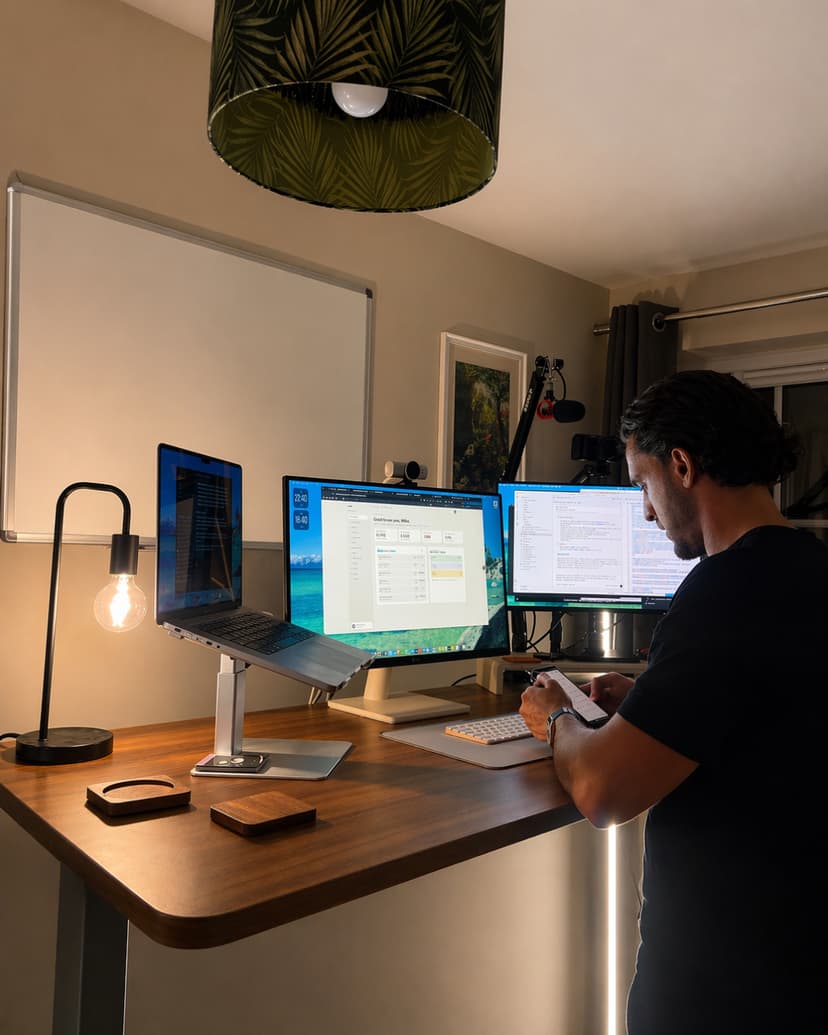
Marketing Agency vs Doing It Yourself: What Every Essex Business Owner Should Know
Honest comparison from an Essex agency founder. When DIY marketing saves money, when an agency pays for itself, and the middle ground most owners miss.
Key Takeaways
- DIY marketing saves cash but costs you time. If you bill £50 to £100 an hour, five hours a week on marketing costs £1,000 to £2,000 a month in your own time.
- You will need tools either way. Ahrefs or Semrush starts at about £100 a month. Canva Pro is £13. Google Ads needs budget on top. An agency already has all of them.
- The learning curve is real. Getting competent at SEO, PPC, and web design from scratch takes six to twelve months of consistent effort. You are learning while competitors who already know are pulling ahead.
- DIY wins when you are very early stage, cash is genuinely tight, and you enjoy the work. Agency wins when you are busy, need results faster, and want someone accountable for the outcome.
- There is a middle ground: you can get agency work without the lock-in. The website, the SEO and the ongoing support are handled together, and you can leave anytime.
I run a marketing agency in Essex, so you would be right to read this with one eyebrow raised. Of course the agency owner is going to tell you to hire an agency. That is fair, and I am not going to insult your intelligence by pretending I do not want your business.
But here is the thing. I have also been the business owner doing it all myself. Before Glide, I was a freelance photographer. I built my own website, taught myself SEO, ran my own ads, wrote my own content, and did my own social media. I know what the 11pm Canva sessions feel like. I know the frustration of spending £300 on Google Ads and getting three enquiries that went nowhere. I have lived both sides of this question.
So this article is not "hire an agency because agencies are great." It is an honest comparison from someone who understands the maths, the learning curve, and the trade-offs. By the end, you will know when DIY is the smart move and when it is the expensive one dressed up as a saving.
The real cost of DIY marketing
When a business owner tells me they are doing their own marketing because it is cheaper, I ask one question: what is your hourly rate?
Most Essex business owners I know bill somewhere between £50 and £100 an hour. Tradespeople, consultants, service business owners. That is what your time is worth when you are doing the thing you are good at.
Now add up the marketing hours. A realistic DIY setup looks something like this each week:
- SEO: Writing or updating a page, checking Search Console, fixing something technical: 2 to 3 hours
- Social media: Creating posts, writing captions, responding to comments: 2 to 3 hours
- Google Ads: Checking campaigns, adjusting bids, writing ad copy, reviewing search terms: 1 to 2 hours
- Email: Drafting a newsletter, setting up an automation, cleaning your list: 1 hour
- General: Reading up on what changed this week, watching a tutorial, trying something new: 1 to 2 hours
That is seven to eleven hours a week, and I am being conservative. Most owners who try to do it all land somewhere around five to eight hours once they settle into a routine.
At five hours a week and £75 an hour, which is a reasonable Essex owner rate, that is £375 a week or £1,500 a month of your own time. At ten hours it is £3,000. And that is before you buy a single tool.
Now compare that to what an agency charges. Our ongoing work covers the website and the SEO together. Suddenly DIY does not look like the cheap option. It looks like spending £1,500 to save on what the ongoing work costs.
But that maths only works if two things are true. First, that you would otherwise spend those five hours doing billable work. If you are early stage with more time than money, the equation flips. Second, that the agency does as good a job as you would. On that point, let me be honest about the learning curve.
The learning curve nobody warns you about
Digital marketing has a brutal knowledge curve. It looks approachable from the outside because anyone can open a Google Ads account or install WordPress in an afternoon. But looking like you know what you are doing and knowing are two very different things, and the gap between them is measured in wasted ad spend and months of flat traffic.
Here is a realistic timeline for getting competent at each channel from a standing start, not expert, just competent enough that your time is not actively hurting your business:
SEO: 6 to 12 months
SEO is the worst offender. You can learn the basics in a weekend: title tags, headings, keyword placement, page speed. But the basics are not enough to move a real business up the rankings against competitors who have been doing this for years.
The things that move the needle take months to learn properly: keyword research that finds terms with intent, not just volume. Internal linking at scale across a site. Schema markup that helps Google understand your pages. Core Web Vitals and the technical side. Link building that does not get you penalised. And the strategy layer: knowing which pages to build first, which keywords to attack in which order, and when to stop optimising and start building something new.
Google also changes. What worked in 2024 is not what works now. AI Overviews, the helpful content updates, the constant core updates. Staying current is a job in itself.
Google Ads: 3 to 6 months
Google Ads is faster to learn than SEO but more expensive to learn on. The platform is designed to take your money whether your campaigns work or not. Every mistake costs real cash.
A beginner will burn through budget on broad match keywords that are too vague, forget to add negative keywords, set the wrong bidding strategy, write ads that get clicks but not conversions, and send traffic to landing pages that do not match the ad. I know because I did all of these things. £300 gone in a weekend with nothing to show for it.
Getting to a point where you can reliably run campaigns that make more than they cost takes most people three to six months of consistent management and learning, and you will lose money along the way. That loss is the real cost of DIY ads.
Web design: 3 to 6 months for something decent
Anyone can build a website with a template in a weekend. But a website that loads fast, looks professional on mobile, guides visitors towards a clear action, and has the technical foundations for SEO is a different job entirely.
Speed alone is a rabbit hole. Image optimisation, code splitting, caching, hosting configuration, font loading. Every one of those has a learning curve and getting any of them wrong means visitors bounce before the page even loads. I covered the detail on what goes into a proper business website in a separate post.
Social media: 1 to 3 months for consistency
Social media is the easiest channel to start and the hardest to sustain. Posting sporadically does almost nothing. You need a content plan, a consistent schedule, decent creative, and the patience to engage even when nobody is engaging back. Most owners post enthusiastically for three weeks and then the business gets busy and social media goes dark.
The bit that runs out first is usually the raw material. You can plan and schedule all you like, but if there is no new footage of your own place, your team and what you sell, you end up reposting the same three photos. That is the gap a content day fills: a crew films at your place for half a day or a full day, then edits it, so you have a batch of finished posts to work through instead of a blank calendar.
Add those timelines up and you are looking at six to twelve months to be genuinely competent across the channels that matter, while still running your business. And during those months, competitors who already know what they are doing are not waiting for you to catch up.
Tools you will need and what they cost
DIY does not mean free. Here are the tools a serious DIY marketer needs and their real-world monthly costs as of 2026:
| Tool | Monthly cost | What it does |
|---|---|---|
| Ahrefs or Semrush | £80 to £120 | Keyword research, competitor analysis, rank tracking, backlink monitoring |
| Canva Pro | £13 | Social media graphics, simple design work, video editing |
| Google Ads (ad spend) | £200 to £1,000+ | Actual ad budget, not a tool cost but a necessary line item |
| Email marketing (Mailchimp, etc.) | £15 to £80 | Newsletters, automations, signup forms |
| Website hosting and domain | £10 to £40 | Hosting, domain renewal, SSL certificate |
| Social scheduling (Buffer, Later, etc.) | £15 to £50 | Schedule posts across platforms, basic analytics |
A realistic DIY tool stack costs £130 to £300 a month before you spend a penny on ads. Add Google Ads at even £300 a month and you are at £430 to £600. You can spend less with free tiers and free tools, but you are trading your time for every pound you save, and the free versions are limited in ways that slow you down.
An agency already has all of these tools, at the top tier, and spreads the cost across clients. That is one of the quieter advantages of outsourcing: you get £500 worth of tools included in the work instead of buying them yourself.
When DIY marketing is the right call
I am not going to sit here and tell you DIY never works. It absolutely can, and for some businesses at some stages it is genuinely the smarter move. Here is when DIY makes sense:
You are very early stage or pre-revenue. If cash is tight and your time is not yet fully booked, DIY is your only real option. Use the free stuff: claim your Google Business Profile, write honest pages about what you do, ask every customer for a review, post on social media when you can. This is how most businesses start, including mine.
You genuinely enjoy it. Some owners love the marketing side. They like writing, they like the analytics, they like learning how Google works. If that is you, do it. You will put in more effort than anyone you hire, and the results will show. Just be honest with yourself about whether you enjoy it or whether you just feel like you should be doing it.
Your business is very local and low competition. If you are a one-person trade business in a small town with three competitors, the SEO bar is low. A completed Google Business Profile, a decent website, and a steady stream of reviews might be all you need. You do not need an agency for that.
You are in a phase where cash preservation matters more than growth. Sometimes the priority is just keeping the lights on. In that scenario, spending nothing on marketing and doing what you can yourself is the right call. An agency retainer should come out of growth budget, not survival budget.
In all of these cases, DIY is not the second-best option. It is the right one. The problems start when owners outgrow DIY and do not notice.
When an agency pays for itself
The moment to hire an agency is not when you can afford one. It is when DIY is costing you more than an agency would. Here are the signs:
You are busy. If you are turning down work or working evenings and weekends to keep up, your time has a real cost. Every hour you spend on marketing is an hour you did not spend doing the thing that makes you money. At £75 an hour, not doing four hours of billable work to do marketing instead costs you £300. An agency doing the same output is suddenly the cheaper option.
You need results faster than you can learn. If you need leads this quarter, not next year, the learning curve is your enemy. An agency with existing skills, existing tools, and existing processes can launch campaigns this week that would take you months to figure out. The agency premium is essentially paying to skip the learning phase.
You want someone accountable for the outcome. When you do it yourself, you are the bottleneck and the safety net. If it does not work, you tweak and try again. That is fine until you are six months in and still not ranking. An agency has someone whose job it is to notice that and fix it. You are paying for accountability as much as execution.
You have tried DIY and stalled. Most owners who call me have done exactly this. They built a site, wrote some pages, ran some ads, got some results, and then plateaued. They hit the limit of what they can do with the knowledge and time they have. That is not failure. That is knowing when to hand over.
Consistency is your weak point. Marketing works through consistency. The weekly blog post, the monthly report review, the quarterly strategy adjustment. If your marketing happens in bursts with long gaps in between, you are paying in lost momentum. An agency delivers the consistency by default because it is literally the job.
The middle ground most owners miss
The marketing industry wants you to believe there are two options: do it all yourself or pay an agency £2,000 a month on a twelve-month contract. Neither feels good, so a lot of owners do nothing and hope word of mouth carries them.
There is a third option and it is the one we built Glide around.
How we work: a professionally built website with the ongoing SEO, hosting and maintenance part of the same job, quoted on what you need rather than picked off a list. No long contract. No lock-in. If you want to leave, you leave. If you want to buy the site outright and take it elsewhere, you can do that too.
The idea is simple. You get agency-quality work without the agency commitment. You get the website, the SEO foundations, the ongoing content, and the monthly reporting that a traditional retainer would give you, but you are not locked in for a year and you are not paying London-agency prices for it.
This works because of how we use AI internally. AI handles the production layer: drafting content, running technical audits, generating schema markup, checking internal links. I handle the strategy, the quality control, and the judgement calls. You get senior-level thinking without paying for senior-level hours on every task. More on that in how I run a marketing agency on AI.
The middle ground is also where DIY and agency blend. Some of our clients do their own social media and email marketing while we handle the website and SEO. Others want us to do everything. You can start small and add more when you are ready, instead of committing to everything on day one.
A real cost comparison
Let me put numbers on this so it is not abstract. Here are three scenarios for an Essex service business that wants to grow through marketing:
Full DIY
| Item | Monthly cost |
|---|---|
| Your time (5 hrs/wk at £75/hr) | £1,500 |
| Ahrefs | £100 |
| Canva Pro | £13 |
| Email tool | £20 |
| Social scheduler | £20 |
| Google Ads (ad spend only) | £300 |
| Total | £1,953/month |
Plus six to twelve months of learning before you are genuinely competent. Total cost in the first year: call it £23,000 in your time plus £6,000 in tools and ads plus whatever you lost running ads badly while you learned.
Traditional agency
| Item | Monthly cost |
|---|---|
| SEO retainer | £800 to £1,500 |
| Google Ads management | £500 to £750 |
| Ad spend | £300 to £1,000 |
| Website (if not included) | £50 to £200 hosting/maintenance |
| Total | £1,650 to £3,450/month |
Competent work from day one, but also a twelve-month contract, a notice period, and potentially a release fee if you want to move your site elsewhere. Plus the awkward discovery in month four that the impressive strategist who pitched you has handed your account to a junior.
What we do instead
We do not have a tier for you to pick, because businesses want different things. One wants the phone to ring. One wants to show up when someone in the next town searches. One needs the website fixed before anything else is worth doing. So we look at all of it first, the website, where you show up in search, your Google Business Profile, your social, and where the enquiries you get now come from, then work out what gets you where you are trying to get to.
The website, the hosting, the maintenance and the ongoing search work are one job rather than a build plus a list of extras. Ads, if they earn their place, sit on top with your media budget separate and visible.
No lock-in. No buyout trap. Cancel anytime. The trade-off is that we are built for local and growing businesses, not enterprise-level national campaigns. If you are competing with Amazon, we are not the right fit and I will tell you that on the call. If you are competing with the other five businesses in your town, we are exactly the right fit.
What the work costs depends on what your business needs, and you get that figure in writing after the first call. No forty-minute pitch before anyone will give you a number.
What a smart DIY-and-agency blend looks like
You do not have to pick a side. The richest approach for most owners I talk to is a blend:
Keep in-house: Google Business Profile management, asking for and responding to reviews, social media posting if you enjoy it, any content where your personal voice matters, and customer emails.
Hand to an agency: The website (design, speed, hosting, technical SEO), ongoing SEO strategy and execution, Google Ads management if you are spending more than £300 a month on ads, and anything you have been meaning to do for three months and have not touched.
This split works because you keep the things where your personal presence adds value and hand over the things where technical skill and consistency matter more than personality. It also keeps your monthly spend lower than a full-service retainer while getting you results faster than pure DIY.
The question to ask yourself
Not "can I afford an agency?" That is the wrong question and it leads to the wrong answer.
The right question is: "Is my current approach to marketing costing me more in lost opportunities than an agency would cost me in fees?"
If you are fully booked and referrals are flowing, the answer is no. Keep doing what you are doing.
If you have time but no cash, the answer is no. Do it yourself, use the free tools, learn as you go. You are in a phase where DIY is genuinely the right call.
If you are busy, turning down work or too stretched to market yourself properly, and you know you are leaving leads on the table, the answer is almost certainly yes. At that point, not hiring help is the expensive option.
And if you are somewhere in the middle, that is exactly who this suits. Agency-quality output at a price that makes sense for a business that is growing but not ready to commit to a twelve-month contract. Our web design, SEO, and PPC pages have the detail on how we deliver each service if you want the specifics.
FAQ
Is it cheaper to do your own marketing?
In cash terms, yes. In real terms, rarely. If your time is worth £50 to £100 an hour, five hours a week on marketing costs you £1,000 to £2,000 a month. An agency doing the same work with existing tools, existing skills, and existing processes will get more done in less time. DIY is cheaper only if your time has no alternative value and you are willing to learn as you go. The moment your time is better spent on your actual business, DIY stops being the cheap option.
Can a small business do its own SEO?
Yes, up to a point. Claiming and completing your Google Business Profile, writing honest service pages, getting customer reviews, and fixing obvious site speed issues are all free apart from your time and they genuinely work for local searches. Where DIY SEO usually falls down is the technical side: schema markup, internal linking at scale, Core Web Vitals, and the consistency required to build momentum. Most owners do a burst of effort and stop. SEO rewards consistency more than intensity. If you are going to do it yourself, commit to a small amount of time every week, not a big push once a quarter.
How long does it take to learn digital marketing?
To get competent across SEO, Google Ads, and web design from a standing start, expect six to twelve months of consistent learning alongside running your business. You can learn the basics of each channel in a weekend, but the gap between basic and effective is where the real work lives. Google Ads in particular is expensive to learn on because every mistake costs real money. Most business owners underestimate the depth of each channel until they are months in and still not seeing the results they expected.
What marketing can I do myself vs hiring an agency?
You can absolutely handle your own Google Business Profile, customer review requests, organic social media posting, service page writing, and simple email campaigns. Where an agency earns its retainer is SEO strategy and execution, Google Ads management, web design that converts, and the consistency of doing all of it month after month. A practical rule: keep the tasks you enjoy and that take under two hours a week. Outsource the rest, especially anything you have been meaning to do for months and have not touched.
Mike McDonnell, Founder of Glide Marketing. More about how I work.
Frequently asked questions
Is it cheaper to do your own marketing?
In cash, yes. In results, rarely. If you bill at £50 to £100 an hour and spend five hours a week on marketing that is £250 to £500 a week of your own time. Over a month that is £1,000 to £2,000. An agency doing the same hours with trained people and paid-for tools will almost always get more done in less time. DIY is cheaper only if your time has no value and you are happy learning as you go.
Can a small business do its own SEO?
Yes, up to a point. Claiming and completing your Google Business Profile, writing honest service pages, getting customer reviews, and fixing obvious site speed issues are all free apart from your time. Where DIY usually falls down is the technical side: schema markup, internal linking at scale, Core Web Vitals, and the sheer consistency required. Most owners do a burst of effort and stop. If SEO is worth doing for your business, it is worth doing continuously.
How long does it take to learn digital marketing?
To get competent across SEO, Google Ads, and web design from scratch, expect six to twelve months of consistent learning alongside running your business. You can get dangerous in a weekend and dangerous is expensive because you waste ad spend and miss opportunities a trained person would catch. Most business owners underestimate how deep each channel goes until they are three months in and still figuring out why their ads are not converting.
What marketing can I do myself vs hiring an agency?
You can absolutely do your own Google Business Profile, ask customers for reviews, post organically on social media, write your own service pages, and run simple email campaigns with a tool like Mailchimp. Where an agency earns its money is SEO strategy and execution, Google Ads management, web design that converts, and the consistency of doing all of it month after month. A good rule: do the things you enjoy and that take under two hours a week yourself. Outsource the rest.