Healthcare Marketing Strategy for Private Practices | 2026

A proven healthcare marketing strategy for UK private clinics. Patient acquisition that delivers 45-60 qualified enquiries in 90 days.
Last updated: 30 April 2026
Key Takeaways
- Most UK private practices rely on word of mouth and consultant referrals. That works, but it is not predictable or scalable.
- A healthcare marketing strategy gives you a system for generating patient enquiries every month, not just when referrals happen to come in.
- The five pillars that matter most: a website built for conversions, local SEO and Google Business Profile, Google Ads for high-intent searches, reviews and reputation management, and content that builds trust.
- You do not need to do everything at once. Start with the channels that move the needle fastest and build from there.
- Compliance matters. The ASA CAP Code and CQC guidelines set the rules for how you can advertise healthcare services in the UK.
Table of Contents
- What is a healthcare marketing strategy?
- Why private practices need a marketing strategy in 2026
- The 7 pillars of a healthcare marketing strategy
- How to build your strategy step by step
- Healthcare marketing trends to watch in 2026
- Common mistakes private practices make
- Healthcare marketing compliance in the UK
- Measuring what matters
- FAQ

What Is a Healthcare Marketing Strategy?
A healthcare marketing strategy is a plan for how your private practice attracts new patients, keeps existing ones coming back, and builds a reputation that grows over time.
It is not just "posting on social media" or "running some Google Ads." It is a connected system. Every piece, your website, your search visibility, your reviews, your content, your ads, works together to move patients from searching for help to booking a consultation with you.
If you run a private clinic, a dental practice, an aesthetic clinic, or you are a specialist consultant, you already know that patients do not just appear. Someone searches "private knee surgeon near me." Someone reads your reviews on Doctify. Someone sees your name on a Google Ads listing. That is marketing. The strategy part is making sure all of those touchpoints are working, not left to chance.
I have spent years helping UK businesses grow at Glide Marketing. The businesses that grow predictably all have one thing in common: they treat marketing like a system, not a series of one-off campaigns.
Why Private Practices Need a Marketing Strategy in 2026
Here is the reality. The UK private healthcare market was valued at $13.75 billion in 2024 and is projected to reach $18.56 billion by 2033. There are 7.29 million patients on NHS waiting lists. More people than ever are going private.
That sounds like good news. And it is. But it also means competition between private practices is getting fierce.
If your growth plan is "wait for GP referrals and hope word of mouth keeps working," you are leaving money on the table. Referrals and word of mouth are brilliant. I would never tell you to stop nurturing those channels. But they are not predictable. You cannot control when a GP refers someone your way.
A marketing strategy for healthcare gives you a second pipeline of patient enquiries. One you can measure, optimise, and scale.
Here is what has changed:
Patients research online before they book. Around 70% of UK internet users now use apps or websites to access or book healthcare services. They Google their symptoms, compare practices, read reviews, and check your website before they ever pick up the phone.
The 35 to 44 age group leads the way. This demographic shows the highest digital healthcare uptake at 78%. These are not passive patients. They are informed consumers making active decisions about where to spend their money.
Reviews are the new referrals. 84% of people trust online reviews as much as personal recommendations. Your Doctify ratings and Google reviews are doing the work that word of mouth used to do.
Self-booking is expected. Practices offering online self-booking see a 20 to 30% lift in new patient conversions. If someone has to phone during office hours to book, you are losing patients to the clinic down the road that lets them book at 10pm on a Sunday.

The 7 Pillars of a Healthcare Marketing Strategy
Every effective healthcare marketing strategy for a private practice comes down to seven things. You do not need to master all seven on day one. But you need to know what they are and build towards them.
1. A Website Built for Conversions
Your website is the front door of your practice. If it loads slowly, looks dated, or makes it hard to book a consultation, nothing else matters.
I have seen private clinics spending thousands on Google Ads driving traffic to a website that has no clear call to action, no trust signals, and a contact form buried three clicks deep. That is burning money.
What a high-converting healthcare website needs:
- Fast load times (under 3 seconds)
- Mobile-first design (most patients search on their phones)
- Clear calls to action on every page ("Book a Consultation," "Request a Callback")
- Trust signals: CQC registration badge, professional body logos, patient testimonials
- Individual practitioner profile pages with photos, qualifications, and specialisms
- Treatment and condition pages that answer patient questions
- Online booking functionality
If your website is not doing these things, that is the first fix. We build high-converting websites for private practices and it is the single biggest lever most clinics underestimate.

2. SEO for Private Healthcare Practices
When someone searches "private dermatologist London" or "knee replacement surgeon near me," you want your practice showing up. That is what SEO for private healthcare practices does.
SEO is the long game. It takes 3 to 6 months to see meaningful results. But once you are ranking, you get a steady stream of patient enquiries without paying for every click.
The key areas of healthcare SEO:
Treatment and condition pages. Every treatment you offer should have its own page, optimised for the terms patients are searching for in real life. "Private hip replacement London" not "arthroplasty services."
Location pages. If you serve multiple areas, you need location-specific pages. "Private clinic Harley Street" and "private clinic Manchester" are completely different searches.
Content marketing. Blog posts that answer patient questions build trust and rank for informational searches. Someone reading your article about "what to expect from a private knee replacement" today might book a consultation next month.
Technical SEO. Site speed, proper heading structure, mobile usability, schema markup. The foundations that make everything else work.
3. Google Business Profile (Local SEO)
For any private practice with a physical location, Google Business Profile is non-negotiable. When someone searches "private GP near me," the map pack results are where the clicks go.
Your GBP needs:
- Accurate name, address, and phone number (matching your website exactly)
- Complete service categories
- Regular posts (weekly updates, offers, practice news)
- Photos of your practice, team, and treatment rooms
- A strategy for generating and responding to patient reviews
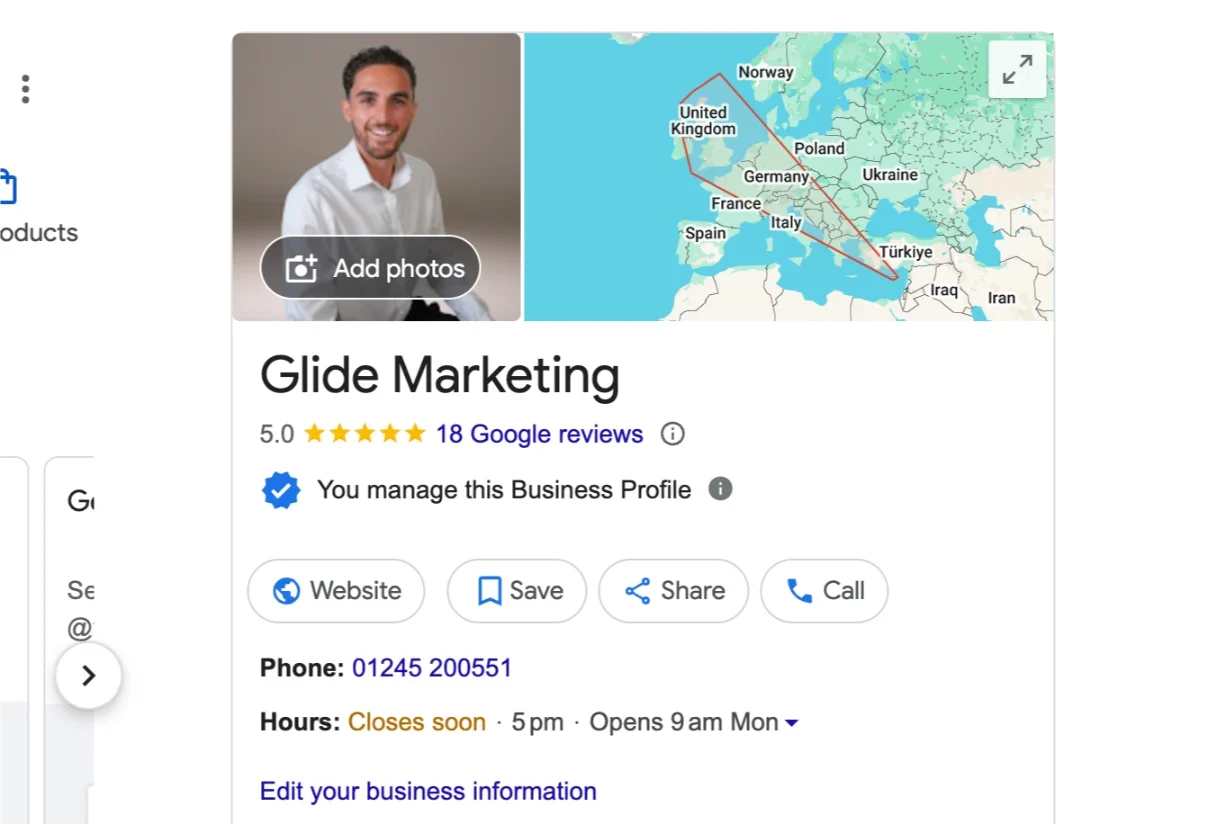
I covered the fundamentals in our local SEO guide, but for healthcare practices, there is an extra layer. Google gives weight to reviews on medical-specific platforms too, so your presence on Doctify, Top Doctors, and iWantGreatCare feeds into your overall visibility.
4. Google Ads (PPC) for High-Intent Searches
SEO takes time. Google Ads management gets you in front of patients today.
For private healthcare, Google Ads works especially well because the searches are high intent and high value. Someone searching "private MRI scan London price" is not browsing. They want to book.
What makes healthcare PPC different:
Cost per click is higher, but so is patient value. A single private patient can be worth thousands. Even at £10 to £20 per click, the return on investment is strong if your website converts.
You need to follow Google's healthcare advertising policies. Google restricts certain medical advertising. You cannot run ads for prescription medications, and some treatment categories have additional restrictions.
Landing pages matter more than ad copy. The page someone lands on after clicking your ad needs to match their search intent exactly. If they searched for "private knee replacement cost," the landing page better talk about pricing, not a generic services page.
Negative keywords save money. Add "NHS," "free," and "jobs" as negative keywords. You do not want to pay for clicks from people looking for NHS services or healthcare jobs.
5. Reviews and Reputation Management
In private healthcare, trust is everything. A patient is choosing to pay for your expertise when they could go through the NHS for free. They need to trust you before they book.
Reviews are the fastest way to build that trust online.
Where private healthcare patients leave and read reviews:
- Google (most important for visibility)
- Doctify (the dominant private healthcare review platform in the UK)
- Top Doctors
- iWantGreatCare
- Trustpilot
Your strategy should include:
- A systematic process for asking satisfied patients to leave reviews
- Responding to every review (positive and negative) professionally
- Featuring reviews on your website and treatment pages
- Monitoring your ratings across platforms monthly
One thing I see practices get wrong: they ask for reviews once, get a burst of them, then stop. Reviews need to be fresh and consistent. Google looks at review velocity, not just total count.

6. Healthcare Content Marketing
Content marketing is how you build authority and rank for the hundreds of informational searches patients make before they are ready to book.
Think about the patient journey. Before someone books a private consultation, they might search:
- "Is a private knee replacement worth it?"
- "How much does a private MRI cost UK?"
- "Best treatment for tennis elbow"
- "What to expect from a private health assessment"
If your practice has a blog post answering those questions, you are the one they trust when they are ready to book.
Effective healthcare content marketing for private practices:
Treatment guides. Detailed pages explaining each procedure, what to expect, recovery times, costs.
Condition explainers. What the condition is, when to seek treatment, why private care might be appropriate.
Cost and comparison content. "Private vs NHS waiting times for hip replacement" is a search with clear intent.
Patient stories and case studies. With proper consent and anonymisation, real patient outcomes build trust like nothing else.
Practitioner expertise content. Position your consultants as thought leaders in their specialisms.
7. Email and Patient Retention
Acquiring a new patient is expensive. Keeping an existing one is not.
Most private practices do nothing to stay in touch with past patients. That is a missed opportunity. A simple email strategy keeps your practice front of mind:
- Welcome emails after first consultation
- Follow-up emails after treatment (checking in on recovery)
- Quarterly newsletters with practice updates and health tips
- Recall reminders for annual check-ups or follow-up appointments
- Exclusive offers for existing patients (health assessments, screening packages)
You do not need a complex marketing automation platform. A simple email tool and a consistent schedule is enough to start.
How to Build Your Healthcare Marketing Strategy Step by Step
Knowing the seven pillars is one thing. Building the strategy is another. Here is how I would approach it if I were starting from scratch with a private practice.

Step 1: Audit where you are now
Before you spend a penny, understand your starting point.
- How are patients currently finding you? (Ask them at reception.)
- What does your website look like on mobile? Is it fast?
- Are you showing up on Google when patients search for your treatments?
- What do your reviews look like across Google, Doctify, and other platforms?
- Do you have a Google Business Profile? Is it complete?
If you want an honest assessment, tell us what you need and we will walk through where the gaps are in your current marketing.
Step 2: Fix your website first
Nothing else works if your website does not convert. Get the basics right:
- Clear calls to action on every page
- Mobile-friendly design
- Fast load times
- Trust signals visible above the fold
- Individual pages for every treatment you offer
Step 3: Claim and optimise your Google Business Profile
This is free and takes an afternoon. Make sure your NAP (name, address, phone) is consistent, add photos, select the right categories, and start posting weekly updates.
Step 4: Start building reviews
Put a system in place. After every positive patient interaction, send a follow-up email or text with a direct link to leave a Google review. Aim for at least 2 to 3 new reviews per month.
Step 5: Invest in SEO or Google Ads (or both)
If you need patients now, start with Google Ads targeting your highest-value treatments.
If you are playing the long game, invest in SEO. Build out treatment pages, condition pages, and content that ranks.
Most practices that work with us do both. PPC campaigns for immediate results, SEO for compounding growth.
Step 6: Create content consistently
One blog post per month minimum. Answer the questions your patients are asking. Cover costs, what to expect, comparisons, and recovery information.
Step 7: Track, measure, refine
Set up Google Analytics (GA4) and Google Search Console. Track where your enquiries are coming from. Double down on what works. Cut what does not.
Healthcare Marketing Trends to Watch in 2026
The landscape is shifting. Here are the trends that matter most for UK private practices right now.
AI search is changing how patients find you. Google's AI Overviews and tools like ChatGPT are summarising healthcare information. Practices with clear, well-structured content on their websites are more likely to be cited in AI-generated answers.
Video content is rising. Short-form video on Instagram and YouTube Shorts is becoming a powerful way for practitioners to build personal brands. A 60-second video explaining a procedure builds more trust than a 2,000-word blog post for some audiences.
GEO (Generative Engine Optimisation) is emerging. This is SEO for AI platforms. Building FAQ content, creating detailed practitioner profile pages, and structuring your content clearly helps AI tools understand and recommend your practice.
Self-booking is expected, not optional. Practices without online booking are losing patients to those that have it. Full stop.
Privacy-first marketing is mandatory. With tightening data regulations, your marketing needs to be compliant from the ground up. Cookie consent, data processing agreements, and proper patient data handling are not optional extras.

Common Mistakes Private Practices Make
I have worked with enough private healthcare practices to know the patterns. Here are the mistakes I see over and over.
Relying entirely on referrals. Consultant referrals are golden. But if your only source of new patients is other doctors remembering to mention your name, your growth is out of your control.
Treating marketing as an expense, not an investment. A new patient at a private clinic can be worth £2,000 to £20,000+ over their lifetime. If your marketing generates 10 new patients a month at a cost of £1,500, that is not an expense. That is the best return you will get on anything.
Ignoring their website. "We got a website built five years ago, it is fine." It is probably not fine. Check it on your phone right now. If it is slow, hard to navigate, or has no clear way to book, it is costing you patients.
Not asking for reviews. Happy patients will leave reviews. They just need to be asked. A simple text message with a link after their appointment is all it takes.
Trying to do everything at once. You do not need TikTok, a podcast, a blog, Instagram, LinkedIn, email marketing, and Google Ads all running in month one. Start with the highest-impact channels and build from there.
Copying what NHS trusts do. NHS marketing and private practice marketing are completely different. NHS marketing is about managing demand. Private practice marketing is about generating it. The strategies, messaging, and channels are different.
Healthcare Marketing Compliance in the UK
You cannot market a private healthcare practice the same way you would market a restaurant or a clothing brand. There are rules. Break them and you risk fines, sanctions, or worse, losing patient trust.
The ASA CAP Code (Section 12). The Advertising Standards Authority's CAP Code sets the rules for healthcare advertising in the UK. You cannot make medicinal claims unless the product is MHRA-licensed. You cannot use before-and-after photos without meeting strict guidelines. You cannot make claims you cannot substantiate with evidence.
CQC registration. If your practice is CQC-registered, display this prominently. It is a trust signal and a compliance requirement. Your marketing should never make claims that conflict with your CQC inspection findings.
Google's healthcare advertising policies. Google restricts ads for certain healthcare categories. You need to be certified to run ads for some treatments, and some categories (like addiction services) require additional verification.
Patient testimonials. You can use patient testimonials, but they must be genuine, not misleading, and compliant with ASA rules. Avoid implied guarantees of outcomes.
Data protection (GDPR). Any patient data you collect through forms, bookings, or email signups must be handled in compliance with GDPR. Privacy policies, consent mechanisms, and data processing agreements are mandatory.
For benchmarking against the wider UK private healthcare market, PHIN publishes data on private healthcare providers, consultants, and outcomes that can inform how you position your practice.
Measuring What Matters
Digital marketing in healthcare is only worth doing if you know what is working. Here are the metrics that genuinely matter for private practices.
Patient enquiries per month. Not traffic, not impressions. How many people contacted you to book? This is the number that pays the bills.
Cost per enquiry. If you are running Google Ads, what does each patient enquiry cost you? For most private healthcare practices, anything under £50 per enquiry is strong.
Organic keyword rankings. Are you moving up for your target treatment and location keywords? Track this in Google Search Console or a tool like Ahrefs.
Google Business Profile insights. How many people viewed your profile? How many clicked to call or visit your website?
Review velocity. Are you getting consistent new reviews each month?
Website conversion rate. What percentage of website visitors are making an enquiry? Anything under 2% means your website needs work.
Return on investment. For every £1 you spend on marketing, how much revenue is it generating? Tie everything back to real patient value, not vanity metrics.
At Glide, we guarantee results. We help UK private healthcare clinics generate 45-60 qualified patient enquiries within 90 days using our proven Patient Pipeline Method. If we don't hit at least 45, we continue working for free until we do. That is how confident we are that this approach works.
FAQ
What is a healthcare marketing strategy?
A healthcare marketing strategy is a structured plan for how a private practice attracts new patients, retains existing ones, and builds its reputation online and offline. It typically includes a website optimised for conversions, search engine optimisation, Google Ads, reputation management, content marketing, and patient retention activities.
How do I market my private practice in the UK?
Start with a fast, mobile-friendly website with clear calls to action. Claim and optimise your Google Business Profile. Build a system for collecting patient reviews. Invest in SEO to rank for treatment and location keywords. Consider Google Ads for immediate visibility. Create content that answers the questions patients are searching for.
How much does healthcare marketing cost?
Costs vary depending on your goals and competition. SEO retainers for private practices typically start from £1,000 per month. Google Ads budgets depend on your specialism and location, but most practices start at £1,000 to £2,000 per month in ad spend plus management fees. A new website ranges from £3,000 to £15,000+ depending on complexity.
What are the best digital marketing channels for private healthcare?
For most UK private practices, the highest-impact channels are SEO (organic search), Google Ads (paid search), Google Business Profile (local visibility), and review platforms like Doctify and Google Reviews. Social media and email marketing support these core channels but rarely drive patient enquiries directly on their own.
Do private healthcare practices need to follow advertising regulations?
Yes. In the UK, private healthcare advertising must comply with the ASA CAP Code (particularly Section 12), CQC guidelines, Google's healthcare advertising policies, and GDPR for data protection. You cannot make unsubstantiated medical claims, and before-and-after imagery must meet strict ASA requirements.
How long does it take to see results from healthcare marketing?
Google Ads can generate enquiries within days of launching. SEO typically takes 3 to 6 months to show meaningful results, depending on competition and your starting point. Review building and content marketing are ongoing activities that compound over time.
Is SEO or PPC better for private healthcare practices?
Both serve different purposes. PPC (Google Ads) delivers immediate visibility for high-intent searches. SEO builds long-term, compounding organic traffic. Most successful practices invest in both: PPC for quick wins and immediate patient flow, SEO for sustainable growth that reduces reliance on paid advertising over time.
How do I get more patient reviews for my private practice?
Create a systematic process. After every positive patient interaction, send a follow-up message with a direct link to your Google review page or Doctify profile. Make it as easy as possible. Respond to every review, positive or negative, professionally and promptly.
Next Steps
If you have read this far, you already know your practice could be doing more to attract patients online. The question is where to start.
Here is what I would suggest: get a clear picture of where you stand right now. Tell us what you need and we will walk through your current marketing, where the gaps are, and what a Patient Pipeline could look like for your clinic.
No sales pitch. No obligation. Just a straightforward assessment of what is working and what is not.
Or, if you want to talk about our Patient Pipeline Method and how we help UK private healthcare clinics generate 45-60 qualified patient enquiries within 90 days, get in touch.
About the author
Mike McDonnell is the founder of Glide Marketing, a digital marketing agency that helps UK service businesses generate more enquiries through SEO, Google Ads and high-converting websites. He leads every client relationship personally. Glide Marketing is rated 5/5 on Google.